

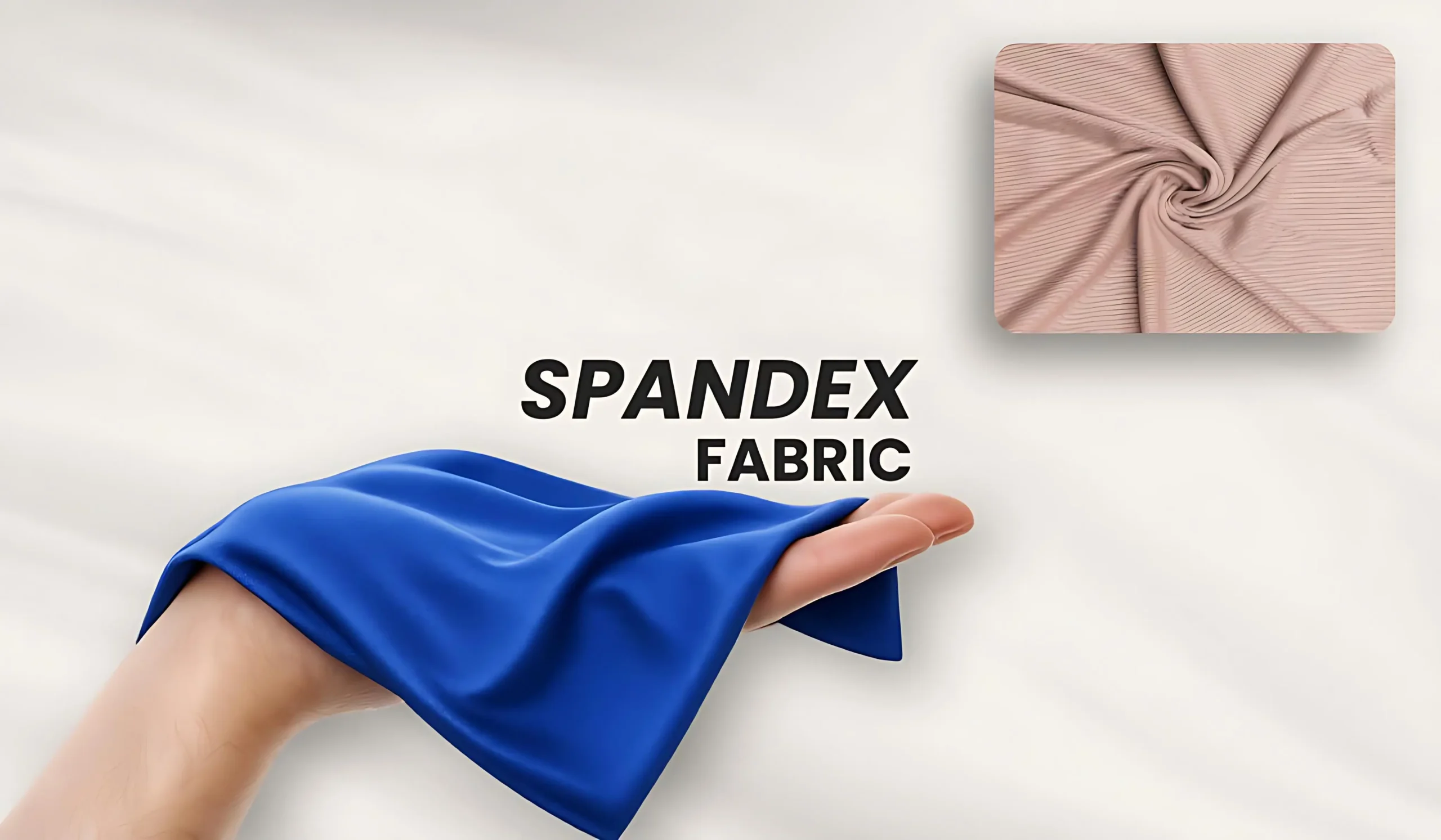
Introduction: What is Spandex Fabric
Spandex, also known globally as elastane, is a highly elastic synthetic fiber renowned for its exceptional stretch and recovery. Characterized by its ability to expand up to five to eight times its original length without losing its shape, spandex is widely used across apparel, performance wear, medical textiles, and industrial applications.
Although often blended with other fibers for support and comfort, its defining feature remains its remarkable elasticity, which transformed modern clothing design and functional textiles.
History of Spandex Fabric
The history of spandex traces back to the mid-20th century, when scientists were searching for an elastic fiber that could outperform natural rubber. The most significant breakthrough came from Joseph C. Shivers, a polymer chemist working at DuPont’s Fiber Research Laboratory.[2]
Throughout the early 1950s, Shivers experimented with segmented polyurethane chains, trying to create a fiber that offered exceptional stretch but remained stable, lightweight, and resistant to degradation. His work culminated in 1958, when he successfully refined a dry-spinning method that produced a durable elastic filament with consistent recovery, something rubber could never achieve.
DuPont quickly recognized the commercial potential of this new elastomer. By 1959, the company introduced the fiber to the market, and it immediately changed the direction of textile manufacturing. As fashion began to embrace more body-conscious silhouettes and as the demand for high-performance athleticwear increased, spandex became central to the development of modern stretch fabrics.
Through the 1960s and 1970s, the fiber moved from a laboratory innovation to a global standard, marking one of the most influential material advancements in the apparel industry, all rooted in Shiver’s pioneering research.[Nytimes]
Origin, Evolution, Key Innovations
Spandex originated from the need for a lightweight and more resilient alternative to rubber-based elastic fibers. Early rubber degraded quickly, absorbed moisture, and lacked long-term recovery. The breakthrough came with the discovery of segmented polyurethane polymers, which combined flexible and rigid molecular segments to produce stretch without permanent deformation.[3]
Over the years, spandex evolved from niche performance textiles into a mainstream fiber integrated into everyday garments.
Key innovation includes:
- Blending spandex with cotton, polyester, and nylon for improved comfort.
- Development of finer yarns suitable for lightweight fabrics.
- Heat-resistant and chlorine-friendly formulations for swimwear.
- Enhanced spinning methods that improved fiber strength and uniformity
Today, spandex is not limited to apparel; it is used in compression materials, filtration components, engineered fabrics, and highly specialized technical textiles.[4]
Manufacturing Process
The manufacturing of spandex involves a combination of chemical synthesis and precise spinning techniques that ensure uniform elasticity.
1. Fiber Selection
Spandex is created from prepolymers produced by reacting a diisocyanate with a macrodiol. These components determine the fiber’s softness, strength, and elasticity. Manufacturers carefully control the polymer composition to suit different end uses, from lightweight apparel to high-strength industrial elastic materials.
2. Spinning Process
Most spandex is produced using the solution dry-spinning method:
- The prepolymer is diluted with solvent to form a thick, viscous solution.
- The solution is pumped through spinnerets, tiny nozzles that shape fiber.
- Warm air passes through the spinning chamber, evaporating the solvent.
- Solidified filaments emerge and are bonded together to create a single, cohesive yarn.
Alternative methods such as reaction spinning and melt spinning exist but are less commonly used due to cost or technical limitations.
3. Blending, Weaving, and Knitting
Spandex is rarely used alone. Instead:
- It is wrapped with fibers like cotton or nylon for softness.
- It is blended during spinning to create stretch knits and wovens.
- It is integrated into fabrics using core-spun, covered, or air-jet yarn techniques.
Knitted fabrics, such as jersey and rib knits, incorporate spandex for comfortable stretch, while woven fabrics like denim or poplin use it to enhance flexibility and fit.
4. Finishing Techniques
After production, spandex undergoes finishing steps that ensure stability and performance:
- Heat-setting to lock in dimensional stability.
- Dyeing with compatible dyes, often in blended form.
- Softening to improve hand feel
- Coating for specific industrial uses
These processes refine the fiber for durability, stretch control, and user comfort.
Properties and Characteristics
- Exceptional elasticity (500-800% stretch): Spandex can stretch several times its original length, allowing garments to move freely with the body without feeling tighter or restrictive.
- High recovery without permanent deformation: Even after repeated stretching, the fiber returns to its original shape, preventing sagging, bagging, or loss of fit over time.
- Lightweight and Smooth texture: The fiber adds stretch without adding bulk, making fabrics feel soft, comfortable, and suitable for both fitted and lightweight garments.
- Resistant to perspiration and body oils: Spandex maintains its elasticity even when exposed to sweat, lotions, or natural skin oils, making it ideal for everyday and active wear.
- Low moisture absorption: Because it doesn’t retain water, spandex dries quickly and feels less heavy during workouts or humid conditions.
- Compatible with multiple fiber blends: It can be combined easily with cotton, polyester, nylon, or rayon to enhance comfort, stretch, and performance in various fabric types.
- Durable under repeated movement: The fiber withstands constant bending, stretching, and twisting, making it reliable in sportswear, dancewear, and compression garments.
- Provides compression when required: Depending on how it’s blended or engineered, spandex can create supportive, body-hugging fabrics used in shapewear and medical textiles.
- Retains shape even in tight-fitting garments: Spandex helps clothes maintain a clean, structured silhouette, preventing the material from loosening or losing form.
- Resistant to wrinkles, abrasion, and creep: It does not wrinkle easily, resists surface damage from friction, and avoids ”creep,” meaning it won’t slowly stretch out every time under tension.
Applications
Spandex plays a central role in modern apparel because it enhances comfort, movement, and fit without adding weight. In everyday clothing, it is commonly blended into jeans, shirts, leggings, dresses, and undergarments to provide subtle stretch that adapts to different body shapes. This makes garments more flexible, supportive, and long-lasting, especially in fitted silhouettes or clothes worn for long hours.
In activewear, spandex helps create garments that move in sync with the body. Sports leggings, cycling shorts, gym tops, swimsuits, and training suits rely on its elasticity to support muscle movement and maintain shape during intense activity. The fiber’s quick-drying nature and resistance to perspiration also make it suitable for fitness and outdoor performance fabrics.
Spandex is equally valuable in medical textiles. Compression stockings, support bandages, braces, and post-surgical garments require controlled elasticity to improve circulation, reduce swelling, or stabilize muscles. Its ability to deliver consistent pressure while maintaining comfort has made it essential in therapeutic and rehabilitative clothing.
Beyond personal wear, spandex contributes to home and uniform textiles as well. It is used in stretch bed sheets, fitted covers, flexible workwear, and dance or stage costumes where movement and fit are a priority. This broad usability reflects the fiber’s versatility across different lifestyles and needs.
Commercial and Industrial Uses
In commercial sectors, spandex is used in products that require both elasticity and long-term durability. Elastic tapes, waistbands, narrow fabrics, and sewing threads often incorporate spandex to ensure flexibility during repeated use. The fiber’s resilience makes it suitable for garments and accessories that undergo constant stretching, such as swimwear bindings, athletic trims, and flexible uniform components.
Industrially, spandex forms part of specialized materials designed for high-performance environments. Automotive interiors sometimes include spandex-blended fabrics for panels or seat covers that must maintain shape despite repeated stress. In filtration systems, certain elastic components benefit from spandex’s ability to stretch and recover without breaking down.
The healthcare industry remains one of the largest non-apparel users. Spandex is integrated into prosthetic liners, orthopedic supports, and medical braces, where elasticity is essential for both comfort and controlled compression. Its stable performance under pressure makes it reliable in devices that must respond to body movement without losing structure.
Spandex also appears in technical and engineered fabrics used in aerospace, industrial uniforms, and protective gear. When combined with high-strength fibers, it helps create materials that can endure strain while remaining flexible. This combination of adaptability and strength has expanded spandex’s role far beyond fashion, positioning it as a key component in multiple specialized industries.
Types of Spandex
- Core-Spun Spandex:
A fine spandex filament is placed at the center while cotton, polyester, or rayon fibers are spun around it. This creates a yarn that feels natural on the outside but stretches from within. It is widely used in denim, everyday apparel, shirting, and leggings because it provides stable, comfortable stretch without exposing the elastic core.
- Air-Covered Spandex:
In this method, spandex is wrapped with nylon or polyester filaments using high-pressure air jets. The result is a softer and more uniform elastic yarn commonly used in hosiery, lightweight sportswear, swimwear, and seamless garments. It blends well with delicate or finely knitted fabrics.
- Hard-Covered Spandex:
This variation wraps spandex with one or two layers of yarn under higher tension. It produces firmer control and stronger stretch resistance. It is typically used in medical bandages, elastic tapes, waistbands, lingerie straps, and industrial elastic components where stability is essential.
- Micro Spandex (Micro-Elastane):
Finer versions of spandex designed for delicate, lightweight, or close-to-skin fabrics. Micro spandex enhances softness, improves drape, and maintains stretch without adding thickness. It appears in athleisure tops, premium lingerie, performance t-shirts, and high-end stretch wovens.
- High-Tenacity Spandex:
Engineered for applications that demand both stretch and strength, this variation has improved resistance to tension, heat, and repeated movement. High-tenacity spandex is used in performance sports gear, protective apparel, technical uniforms, and industrial elastic materials that must withstand demanding conditions.
- Chlorine-Resistant Spandex:
Traditional spandex weakens when exposed to pool chemicals, so this improved version is formulated to withstand chlorine, UV exposure, and repeated washing. It is ideal for swimwear, triathlon suits, aquatic sports uniforms, and poolside apparel.
- Solution-Dyed Spandex:
Although less common, some manufacturers dye the fiber during spinning to improve colorfastness and reduce water usage. This variation enhances durability and is used in color-sensitive garments like activewear and special uniforms.
- Bi-Stretch/ Four-Way Stretch Blends:
While not a “type” of spandex fiber itself, this category refers to fabrics engineered using spandex to stretch both horizontally and vertically. These blends are popular in athleisure, body-contouring garments, and tailored clothing that needs flexibility without losing structure.
Environmental Impact
The environmental impact of spandex begins with its raw materials. Since it is made from segmented polyurethane, a product of petroleum-based chemicals, its production depends on non-renewable resources.
This reliance on non-renewable resources makes the fiber inherently less sustainable than natural or biodegradable alternatives. The polymer synthesis process also requires specific chemical reagents and stabilizers, many of which must be handled with caution to avoid environmental contamination. This early stage of manufacturing sets the foundation for most of spandex’s ecological concerns.
Energy consumption is another major factor. Spandex is primarily produced through solution dry-spinning, a technique that involves evaporating solvents at controlled temperatures. Maintaining these conditions uses significant electricity, contributing to the fiber’s carbon footprint.
Although many factories have improved energy systems over the years, the global scale of spandex production still places a considerable load on industrial energy demand, especially in countries where coal remains a primary energy source.
One of the biggest challenges with spandex is its lack of biodegradability. Because the fiber is synthetic and chemically stable, it does not break down naturally in soil or water. When clothing containing spandex ends up in landfills, it can remain intact for decades.
Blended fabrics pose an additional challenge: separating spandex from cotton, polyester, or nylon during recycling is extremely difficult with current technology. As a result, most stretch fabrics cannot be recycled at scale, increasing long-term waste accumulation.
Environmental concerns also extend to microfiber pollution. When spandex-blended fabrics are washed, small synthetic particles can enter waterways. Although microfiber shedding from spandex alone is lower than from polyester, its presence in blended materials still contributes to overall problem. These microfibers can travel through wastewater systems and eventually reach oceans, affecting marine life and the food chain.
Despite these issues, several sustainability initiatives are emerging. Many manufacturers now use solvent recovery systems that capture and reuse chemicals instead of releasing them into the environment. Some companies are experimenting with partially bio-based elastane or improving durability so garments last longer before disposal.
Others incorporate spandex into fabrics designed for circular recycling, though these processes are still in early development. While these advancements do not eliminate environmental concerns, they show a gradual shift toward more responsible production practices.
Spandex vs Lycra
| Feature | Spandex | Lycra |
| Type | Generic fiber (elastane) | Trademarked elastane fiber |
| Stretch Capacity | 5-8 times original length | Similar, often optimized |
| Durability | High, varies by producer | Consistent due to brand standards |
| Cost | Generally lower | Slightly higher due to brand quality |
| Availability | Widely available | Restricted to specific manufacturers |
| Applications | Apparel, medical, technical | Similar, with premium-performance focus |
Notes:
- https://www.invent.org/inductees/joseph-c-shivers-jr
- https://www.invista.com/
- https://www.sciencedirect.com/science/article/abs/pii/0079670091900119
- https://www.textileschool.com/30926/the-complete-guide-to-spandex-fabric-from-revolutionary-fiber-to-sustainable-future/
References:
- https://www.invista.com/
- https://www.textileschool.com/30926/the-complete-guide-to-spandex-fabric-from-revolutionary-fiber-to-sustainable-future/
- https://cen.acs.org/business/biobased-chemicals/Worlds-biggest-spandex-maker-biobased/102/web/2024/04
- https://www.textileschool.com/30926/the-complete-guide-to-spandex-fabric-from-revolutionary-fiber-to-sustainable-future/
- https://www.fibre2fashion.com/market-intelligence/texpro-textile-and-apparel/textile-guide/10536/spandex-fabric
- https://www.sciencedirect.com/science/article/abs/pii/0079670091900119
- https://davonne.co/the-spandex-material/
- https://www.textileindustry.net/uses-of-spandex/
- https://yanmaotextile.com/essential-guide-to-spandex-characteristics-uses-and-care-tips/
Programs
- If you are exploring the idea of starting a fashion brand – Join the Masterclass
- If you are 100% sure of launching a clothing brand or are in the process of launching a clothing brand – Join the Bootcamp
- If you are looking for low MOQ supplier, inquire about the Co-pilot program.
- If you have a private label brand and you are looking to scale up – Join our Private Label Program.
- If you are looking for surplus & Liquidation deals – join our liquidation program.
- If you are not sure about joining the bootcamp, – Join the Masterclass to get a feel of what Bootcamp has to offer and if you still have questions, you can email us at hello@hulaglobal.com
Read more