

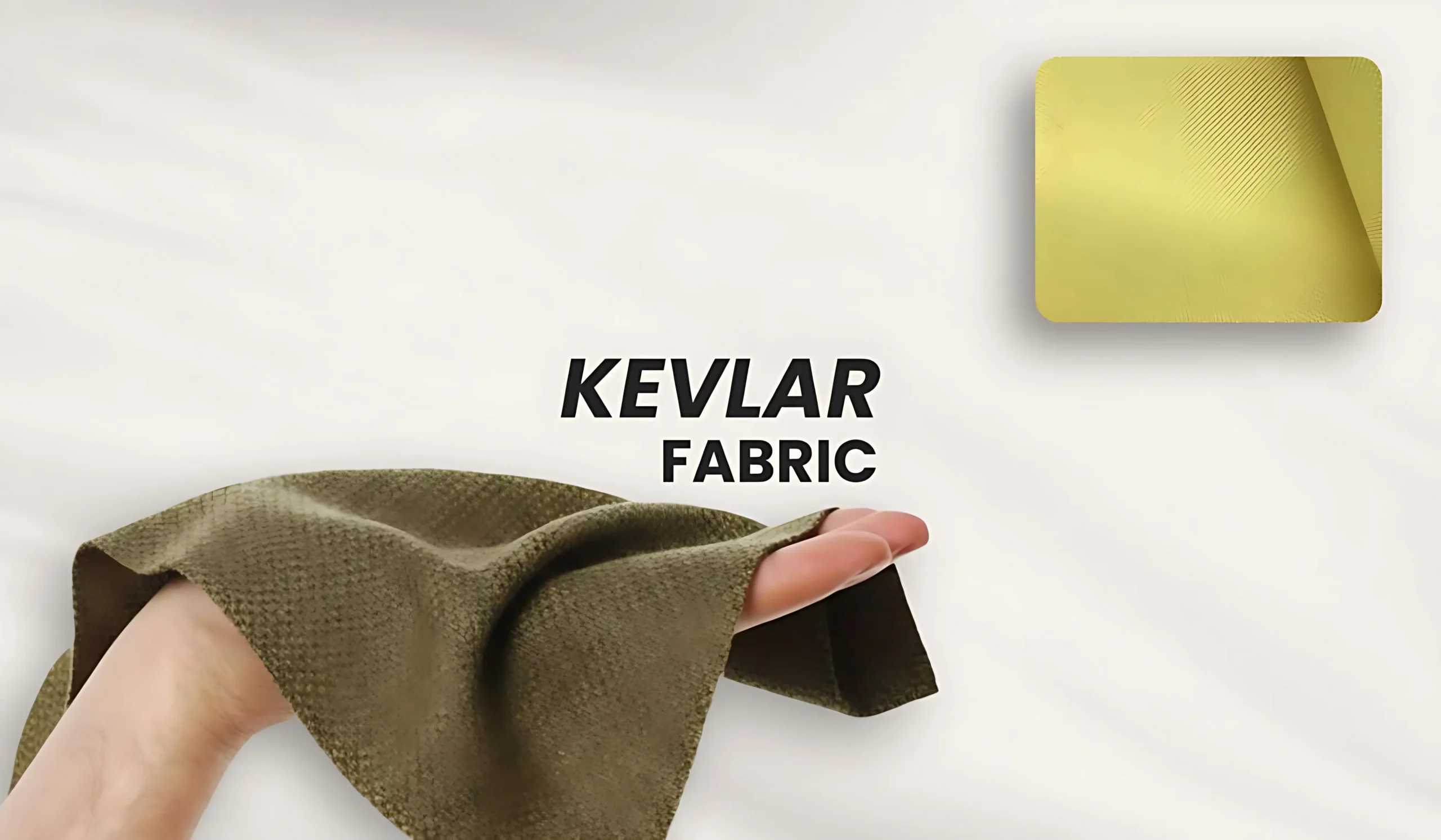
Introduction: What is Kevlar Fabric?
Kevlar fabric is one of the most advanced and high-performance textiles ever made, globally recognized for its strength, durability, and heat resistance. Developed by DuPont in 1965, Kevlar is a para-aramid synthetic fiber engineered at the molecular level to have extremely high tensile strength without weighing down the material.
This combination of lightness and strength is a game-changer in industries where protection, structural integrity, and reliability are key.
Unlike other fibers, Kevlar has rigid, highly oriented polymer chains bonded through strong hydrogen interaction, which can withstand immense force and prevent breakage under stress. Over the years, Kevlar has evolved from a reinforcement material in tires to a cornerstone of modern safety and industrial textiles.
Today Kevlar is used in applications such as bulletproof vests, tactical helmets, aerospace composites, industrial gloves, reinforced cables, marine construction, and high-performance sporting equipment.
Beyond strength, Kevlar also offers high temperature, chemical, cut, and abrasion resistance, making it suitable for environments where standard textiles would fail quickly. Its versatility, long life, and precision engineering have made Kevlar one of the most trusted materials in advanced textile manufacturing and global defense industries.
History of Kevlar Fabric
Kevlar was first made in 1965 by DuPont chemist Stephanie Kwolek, who found a polymer solution that, when spun, produced fibers with incredible strength.
Commercial production started in the early 1970s and was initially used to reinforce tires as a lightweight alternative to steel.
Over time, Kevlar went far beyond automotive use: its ballistic properties made it a staple in body armor, its thermal stability and chemical resistance made it useful in aerospace, marine, and industrial applications.
Key innovations include the dry-jet wet spinning process to produce highly oriented fibers and the development of specialized versions, for example, Kevlar KM2 for fragmentation resistance in military helmets. 6
Manufacturing Process of Kevlar Fabric
The fabrication of Kevlar material is made more difficult when trying to obtain the desired strength, molecular alignment, and structural characteristics. Kevlar fabric manufacturing starts with the selection of suitable fibers, and then passes through various processing steps, including controlled spinning, weaving, and finishing. The polymer is converted into a multi-purpose high-performance fabric that can be used in various high-end industrial and protective uses.
1. Fiber selection
The production of Kevlar starts with the chemical reaction of the polymer, para-aramid, with the units of p-phenylenediamine and terephthaloyl chloride. That reaction yields poly-para-phenylene terephthalamide (PPTA), a crystallizable and solid polymer. The polymer is then dissolved in concentrated sulfuric acid to form a spinning solution that is aligned along the chain’s axial direction. The final fiber’s composition and structural stability of the solution are the key factors that will affect the fiber’s overall strength, heat resistance, and durability.
2. Weaving/ Knitting
After the drawing and spinning processes are done, the final Kevlar fibers produced will be woven into fabric that is made on industrial high-tension weaving looms. The most common woven fabric uses a plain weave pattern for a balanced, stable fabric. However, for a more flexible and composite fabric that is used for energy ballistic absorption, a twill weave can be used. The woven fabric that is made ultimately is based on the desired applications, whether that is body armor or components for aerospace materials.
3. Finishing Processes
In terms of strengthening the fabric and its applications, once the weaving of the fabric is done, certain finishing procedures are done, such as heat setting to enhance the fabric, surface sizing to increase the fabric’s joinability, coating for added resistance, and laminating for industrial composite applications. All of these finishing enhancements treat the fibers to further enhance their surface properties as they prepare the final fabric for its tech applications.
Properties & Characteristics of Kevlar Fabric
1. Increasing Strength
Since the company started, Kevlar has always taken the lead in the field of woven textiles for composites, especially in protective apparel. This is due to the extreme tensile strengths the woven fabric has, which are in the region of five times stronger than the best metal. This will lead to unmatched protective capabilities as the protective apparel is body armor and helmets, as well as the protective composites that need to resist heavy impacts.
2. High Mobility
In every field that uses protective apparel, they all agree that the protection should be in a form that does not hamper the wearer’s movement. This has to be taken to extreme levels in the aero and automotive industries. All structural components must be in place, mechanically and with a high enough protective surface to withstand high enough challenges. This must also be done without excessive added bulk, which is also the same for the wearer’s mobility. Kevlar has a high enough tensile strength to offer this in extreme levels.
3. Excellent Thermal Resistance
Kevlar does not melt like most synthetic fibers. Kevlar retains its strength at over 400 °C. This honest heat stability means Kevlar can be relied on in industrial firefighting equipment, aircraft insulation, etc., where extreme heat is constant or prolonged.
4. Naturally Flame Resistant
Kevlar does not require a chemical treatment to be flame-resistant. Kevlar chars, rather than melting or dripping, when exposed to a flame, reduce secondary injury. This is useful when there is a risk of hot surfaces, open fires, or sparks, as in welding, rescue, and military operations.
5. Resistant to Cutting and Abrasion
Kevlar’s molecular structure is why it’s so resistant to cutting, tearing, and abrasion, and it’s why even constant friction and pressure do not wear the fabric down. For this reason, Kevlar is used in protective gloves, industrial sleeve guards, conveyor systems, and other materials that endure lots of contact with sharp objects, or in mechanical systems that face extreme stress.
6. Low Creep and Dimensional Stability
Negligible amounts of creep mean that Kevlar fabrics will stretch very little and change shape almost negligibly when subjected to tension over long time intervals. This allows Kevlar to serve perfectly and retain all required functionalities and mechanical properties over long service time horizons required of cables, belts, aerospace components, and composites.
7. Chemical Resistance
Kevlar performs very well within a wide range of fuels, solvents, and industrial chemicals, enabling it to function under extremely harsh processing conditions. While it is true that Kevlar fibers become slightly weakened after prolonged exposure to strong acids and strong alkaline solutions, it is also true that Kevlar is still chemically durable enough to be used in ammonia in chemical plants, chemical laboratories, and in the construction of marine structures that are at risk of contamination.
8. Excellent Impact Absorption
Perhaps one of the most unique properties of Kevlar is that it can absorb and disperse impact. This is achieved through tightly aligned polymer chains, which, when subjected to impact, will stretch and focus the impact onto a larger region, thus aiding in ballistic protection. This is why Kevlar is used when people need to absorb a lot of energy in a short time.
| Property | Kevlar | Steel | Nylon |
| Tensile Strength / Weight | Very high | Moderate to high | Low–moderate |
| Thermal Resistance | Excellent | Poor (melts) | Moderate |
| Density | Low | High | Medium |
| Creep (under load) | Very low | Moderate | Higher |
| Corrosion / Chemical Resistance | Good (some acids bad) | Prone to corrosion | Good with many chemicals |
Applications of Kevlar Fabric
Lightweight, yet one of the strongest protective materials around, Kevlar is used in both civilian and industrial markets that are legally and commercially allowed to use it. It is the only material that can outperform other fabrics in problems that require extreme protective and durable safety solutions.
1. Body, Arm, and Equipment
Kevlar fabric is used in the absorption and dissipation of impact energy as in tactical safety vests, ballistic combat helmets, stab weapons and riot control arms, and protective ballistic plates, riot control, and protective combat tactical vests. Kevlar is used in military, police, and other protective applications, as fabric integrity is an extreme threat to human safety.
2. Space and Air Travel Components
Aerospace and Air Travel, Aircraft and Spacecraft, Kevlar supports composite structures to increase overall stiffness and decrease structural weight. It is used in composite structures and radomes, aircraft seating and insulating panels, and fuselage fairings. Kevlar’s low density and fatigue resistance in demanding aerospace environments a contributors to long-term performance and better fuel efficiency.
3. Automotive Industry and Tire Reinforcement
The initial use of Kevlar was as an alternative, lightweight option to steel to be used in tire construction. Today, it is used in reinforced tires, timing belts, brake parts, and heat shields in automotive under-hood areas. Kevlar is suited for the mechanical, thermal, and rotating challenges presented by high-performance and commercial vehicles.
4. Cut-Resistant and Industrial Safety Gear
Kevlar is the fiber of choice for gloves, aprons, sleeves, and protective overalls used in construction, factories, metal processing plants, and assembly plants. The fiber’s cut, slash, and abrasion protective qualities allow the worker to safely discard scissors, use tools, and machinery in the heavy industrial activities of the operation.
5. Marine, Ropes, And Structural Cables
Kevlar is used for mooring lines, structural cables, deep-sea tethering systems, and yacht rigging. In several marine situations, it has advantages over metals due to its non-stretch, high strength, and corrosion resistance. It retains its qualities under stress, saltwater, and mechanical movements.
Variations/Types of Kevlar Fabric
Kevlar as a fibre seems to signify a single product, when in fact, it is a family of specialized fibers called para-aramids, manufactured to suit different performance requirements. Each kind is tailored for specific uses through modifications in molecular configuration, tensile strength, and reinforcement properties. It is for this reason that Kevlar finds numerous applications in various types of ballistics, industrial, aviation, and composite products.
1. Kevlar 29
Of all Kevlar grades, this was the first to be commercially sold. It was a breakthrough product because of its unique properties of remarkably high strength and energy absorption. Kevlar 29’s exceptional properties have led to its widespread use in fabrics that protect the body and other textiles that require high tensile strength, as they are intended for use in impact areas. Its combination of strength and durability has led to its popularity in the industry.
2. Kevlar 49
This is another Kevlar brand, but designed to have a higher modulus. It is therefore stiffer and is thus a go-to for composite materials that require additional strength. Its applications are in areas that require strength, stability, and rigidity, like aviation, high-durability sports items, fiber-reinforced plastics, and marine structures.
3. Kevlar KM2 / KM2+
This is the military grade Kevlar brand, and its use is highly sought in tactical combat equipment such as combat armor and tactical helmets. KM2+ has of late gained popularity because it can be used to design lightweight armor, but with high ballistic standards that are still very protective.
4. Kevlar K119
This is a short-strand fiber used in molding compounds, friction materials, gaskets, insulations, and nonwovens, providing improved wear resistance and structural reinforcement.
5. Coated/Laminated Kevlar Fabrics
This version includes Kevlar fabrics laminated with polymers and resins for advanced composite uses like aircraft panels, radomes, racing cars, and high-performance protective engineering.
Environmental Impact / Sustainability of Kevlar Fabric
Kevlar has an environmental footprint. On one hand, its long life in composites, body armor, and structural materials means material efficiency and less waste. It lasts longer than conventional materials. But the manufacturing involves harsh chemicals (polymerization uses strong acids, e.g., sulfuric acid), and the fiber is not biodegradable.
Recycling Kevlar is hard: mechanical recycling degrades the high performance, and chemical recycling isn’t widespread. End-of-life Kevlar composites go to landfills or require energy-intensive incineration.
So while Kevlar is an incredibly high-performance material, it’s not inherently sustainable in a circular economy sense unless recycling technologies and waste management improve.
Comparison Table (versus common technical fibers)
Here’s a comparison of Kevlar, Carbon Fiber, and Ultra-High-Molecular-Weight Polyethylene (UHMWPE) (used in technical fabrics):
| Feature | Kevlar | Carbon Fiber | UHMWPE (e.g., Dyneema) |
| Tensile Strength | Very high | Very high | Very high |
| Weight | Moderate-low | Low | Very low |
| Impact Resistance | Excellent | Brittle | Excellent (but creep) |
| Thermal Stability | High | Moderate | Moderate-low |
| UV / Environmental Degradation | Good resistance | May degrade | Poor (UV sensitive) |
| Recycling Potential | Difficult | Emerging | Emerging but complex |
References
- DuPont. (2019). DuPont Kevlar® Technical Guide. DuPont.
- May, P. (2010). Kevlar: The Super-Tough Fibre. University of Bristol, Molecule of the Month.
- TextileEngineering.net. (2025). Kevlar Fiber: Properties, Types and Uses.
- GKToday. (2025). Kevlar – History, Uses and Characteristics.
- Metallurgy for Dummies. (n.d.). What Is Kevlar?
- Wikipedia
Programs
- If you are exploring the idea of starting a fashion brand – Join the Masterclass
- If you are 100% sure of launching a clothing brand or are in the process of launching a clothing brand – Join the Bootcamp
- If you are looking for low MOQ supplier, inquire about the Co-pilot program.
- If you have a private label brand and you are looking to scale up – Join our Private Label Program.
- If you are looking for surplus & Liquidation deals – join our liquidation program.
- If you are not sure about joining the bootcamp, – Join the Masterclass to get a feel of what Bootcamp has to offer and if you still have questions, you can email us at hello@hulaglobal.com
Read more
How Big of a Deal is the Supply Chain?
Top 20 Expensive Clothing Brands
Iconic Products Made from Leather Jacket
How Do You Start A High-End Clothing Line?