

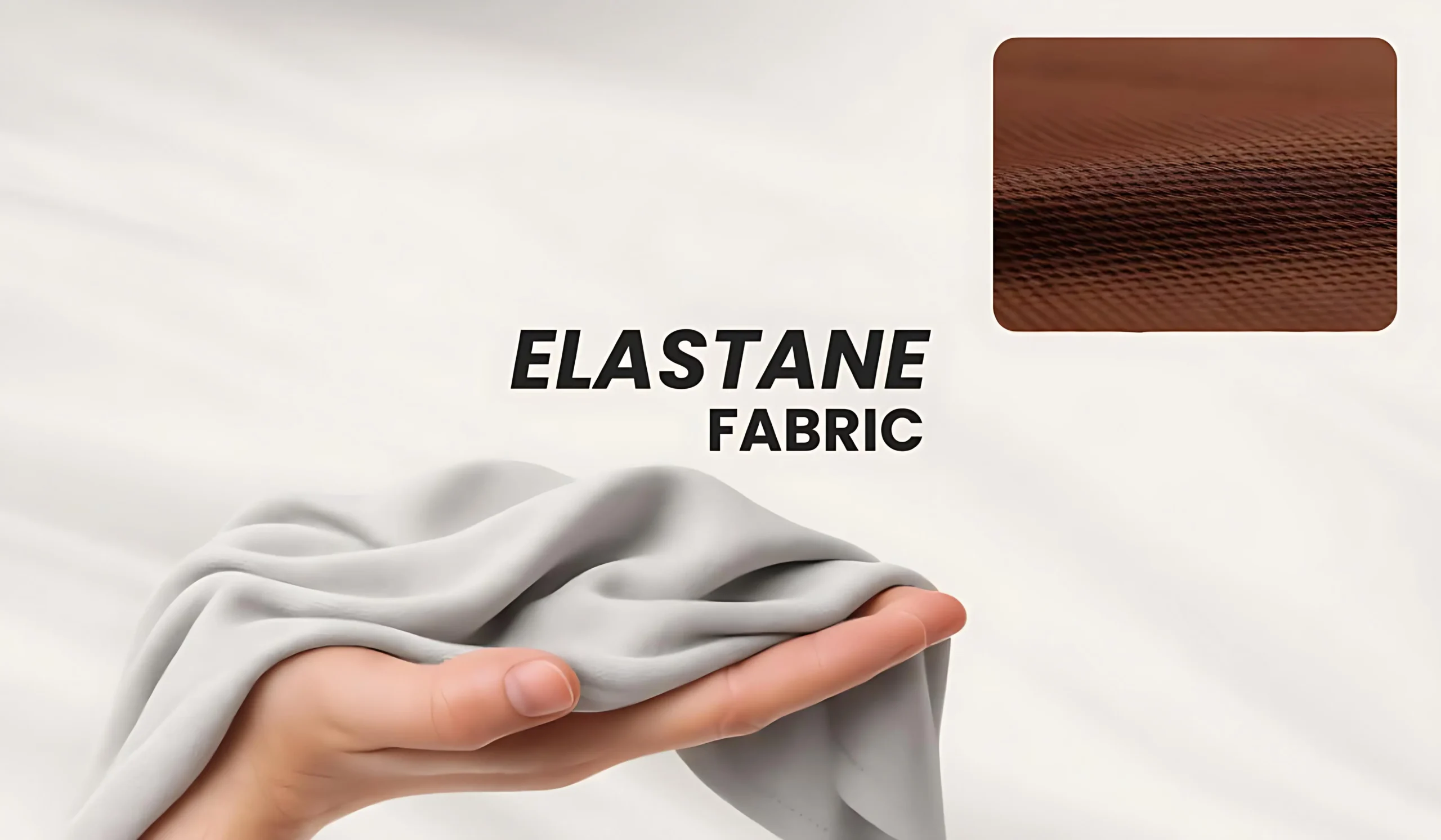
Introduction: What is Elastane Fabric
Elastane is a synthetic fiber known for one defining quality: exceptional stretch. Unlike most textile fibers that offer limited flexibility, elastane can stretch several times its original length and still return to its original shape without losing strength.
This unique ability has made it an essential component of modern clothing, especially where comfort, fit, and movement matter. Although it is rarely used on its own, even a small percentage of elastane blended with other fibers can dramatically improve how a fabric behaves on the body.
Technically, elastane is an elastomeric fiber made from polyurethane-based polymers and is also referred to as spandex in the United States. In everyday scenes, giving jeans their stretch, helping activewear move with the body, and allowing garments to retain shape after repeated wear.
Over time, elastane has shifted from being a performance-specific material to a near-invisible necessity in everyday textiles, redefining how modern fabrics balance structure with comfort.
History
The story of elastane begins in the mid-20th century, at a time when the textile industry was actively searching for a reliable alternative to natural rubber. Rubber offered stretch but came with serious limitations; it degraded quickly, was sensitive to heat and sweat, and lacked long-term durability.
In the 1930s, the development of polyurethane chemistry laid the groundwork for a new kind of elastic fiber, though its textile potential was not immediately realized.
A major breakthrough came in 1958 when chemist Joseph Shivers, working at DuPont’s Benger Laboratory in the United States, successfully developed the first commercially viable elastomeric fiber. This fiber, later introduced to the market as spandex, combined high elasticity with strength, lightness, and resistance to wear, qualities that rubber-based materials could not sustain over time.
By the early 1960s, elastane had entered commercial production and quickly gained popularity in hosiery, undergarments, and performance clothing. Its adoption marked a turning point in garment engineering, allowing designers to create clothing that adapted to the human body rather than restricting it
Once elastane proved its reliability, its use expanded rapidly across fashion and functional textiles. By the late 20th century, it became a standard component in denim, sportswear, and everyday apparel worldwide. Today, elastane is considered less of a specialty fiber and more of a structural support material, one that reshaped expectations of comfort, fit, and durability in modern clothing.
Origin, Evolution, Key Innovation
Elastane originates entirely from synthetic chemistry rather than natural sources. It is produced using polyurethane-based polymers, making it a man-made fiber designed specifically to achieve controlled elasticity.
Unlike natural fibers that inherit their properties from biological structures, elastane’s behavior is engineered at molecular level. Its polymer chains consist of alternating soft and rigid segments, a structure that allows the fiber to stretch extensively under tension and then retract smoothly once the force is released.
This molecular design is what differentiates elastane from conventional synthetic fibers such as polyester or nylon, which prioritize strength over flexibility.
The evolution of elastane reflects changing needs in clothing and textile performance. Initially developed to replace rubber in garments, elastane quickly proved to be superior due to its lighter weight, resistance to sweat and body oils, and long-term durability.
As textile technology advanced, manufacturers began blending small percentages of elastane with other fibers to enhance comfort without altering the fabric’s appearance. This blending approach allowed elastane to move beyond niche applications like hosiery and shapewear and become a hidden but essential element in everyday clothing such as denim, casualwear, and sports apparel.
The Key innovation of elastane lies in its exceptional stretch-and-recovery capability. While most fibers lose shape after repeated use, elastane can repeatedly stretch up to several times its original length and still return to its original form.
This stretch-and-recovery property of Elastane fabric transformed garment construction by enabling closer fits, improved freedom of movement, and longer-lasting shape retention. Rather than being a visible fabric choice, elastane functions as a performance enhancer, quietly improving how garments move, fit, and endure over time.
Manufacturing Process
The production of elastane is a carefully controlled industrial process that combines chemical synthesis with precision spinning techniques. It begins with the selection of raw chemical components rather than natural fibers.
The core material used in elastane manufacturing is polyurethane, formed through a chemical reaction between long-chain polyols and two isocyanates. These components are chosen specifically to create a polymer structure that balances flexibility and strength, which is essential for achieving high elasticity and durability.
Once the polyurethane polymer is created, it is transformed into fibers through a spinning process, most commonly known as solution dry spinning. In this method, the polymer is dissolved in a solvent to form a viscous solution, which is then forced through fine holes in a spinneret.
As the solution emerges, it is exposed to heated air, causing the solvent to evaporate and solidify the polymer into continuous filaments. These filaments are still soft at this stage and are mechanically stretched to align the polymer chains, a step that significantly enhances the fiber’s elastic performance.
After stretching, the elastane fibers undergo finishing treatments to improve stability and handling. Finishing may include applying protective coatings to reduce stickiness and prevent fibers from clinging together during storage and transport.
The finished elastane yarns are then wound onto spools and are ready to be integrated into textile production. Rather than being woven or knitted on their own, elastane fibers are usually combined with other yarns during weaving or knitting processes, allowing fabrics to gain stretch properties while retaining the appearance and texture of the base fiber.
Properties and Characteristics
- Exceptional elasticity: Elastane can stretch up to five to seven times its original length, without breaking, making it one of the most elastic textile fibers available.
- Excellent shape recovery: After stretching, the fiber quickly returns to its original form, helping garments maintain fit and structure over time.
- Lightweight nature: Elastane adds minimal bulk to fabrics, allowing stretch without significantly increasing fabric weight.
- High tensile strength: Despite its flexibility, elastane is strong and resistant to repeated stress and strain.
- Comfort enhancement: When blended with other fibers, it improves wearer comfort by allowing greater freedom of movement.
- Resistance to body oils and perspiration: Elastane performs well in active and close-to-skin garments without degrading quickly.
- Low moisture absorbency: The fiber does not absorb much moisture, which helps it dry quickly but also means it is rarely used alone.
- Sensitive to heat and chlorine: Prolonged exposure to high temperatures or chlorinated water can reduce elasticity over time.
Applications
Elastane is widely used in apparel where flexibility, comfort, and fit are essential. In everyday clothing, Elastane is most commonly blended in small percentages with fibers such as cotton, polyester, or denim to improve stretch and ease of movement.
Elastane fabric is particularly noticeable in garments like jeans, trousers, and fitted tops, where elastane allows the fabric to adapt to body movement while maintaining its original shape. Elastane fabric’s ability to enhance comfort without altering the visual appearance of the fabric has made it a preferred choice in modern casual wear.
In performance and activewear, elastane plays a more functional role. Sportswear, yoga wear, and athleisure garments rely on its stretch and recovery properties to support dynamic movement and physical activity. Elastane allows garments to move with the body rather than restrict it, reducing strain during exercise.
Similarly, in swimwear and lingerie, elastane ensures a close, supportive fit that remains stable even when exposed to water or repeated wear. Across these applications, elastane acts as a performance enhancer rather than a primary fabric, making it an indispensable component in contemporary textile design.
Commercial and Industrial Uses
Beyond fashion and everyday clothing, elastane plays an important role in several commercial and industrial sectors where controlled stretch and durability are required. In the healthcare and medical textile industry, elastane is used in compression garments, support bandages, and orthopedic products. These applications rely on the fiber’s ability to apply consistent pressure while remaining comfortable for prolonged wear. The reliability of elastane in maintaining elasticity over time makes it especially suitable for medical use, where performance and safety are critical.
Elastane is also used in professional performance gear and technical textiles. Protective clothing, performance uniforms, and specialized workwear often incorporate elastane to improve mobility without compromising structural integrity. In industrial settings, elastane contributes to products that require flexibility under stress, such as stretch components in safety gear and engineered textile systems. Although it remains largely invisible to the end user, elastane’s presence in these applications highlights its importance beyond aesthetics, serving functional and performance-driven purposes across multiple industries.
Types of Elastane Fabric
- Bare elastane yarn: Used directly in fabric construction where maximum stretch is required, commonly found in hosiery and lightweight knit fabrics.
- Covered elastane yarn: An elastane core wrapped with another fiber such as cotton, nylon, or polyester to improve durability, appearance, and ease of handling.
- Core-spun elastane yarn: Elastane is placed at the center of the yarn and spun together with staple fibers, widely used in stretch denim and woven fabric.
- Power elastane: High-tension elastane designed for applications requiring strong compression and firm support, such as shapewear and performance sportswear.
- Comfort elastane: Lower stretch variants used in casualwear to provide ease of movement without excessive tightness.
- Solution-dyed elastane: Pigment is added during polymer formation, resulting in improved color consistency and resistance to fading.
Environmental Impact
Despite its functional advantages, elastane presents several environmental challenges that have become increasingly relevant in discussions around sustainable textiles. Elastane is derived from petrochemical sources, making it a non-renewable, fossil-fuel-based fiber. Its production involves energy-intensive chemical processes and the use of solvents, which can contribute to greenhouse gas emissions and industrial waste if not properly managed. As a result, elastane has a higher environmental footprint compared to many natural fibers.
Another major concern is elastane’s durability in the environment. The fiber is non-biodegradable, meaning garments containing elastane can persist in landfills for decades. Additionally, elastane is rarely used alone and is typically blended with other fibers, making textile recycling extremely difficult. These blended fabrics are hard to separate mechanically or chemically, which limits their recyclability and often leads to downcycling or disposal rather than reuse.
From a consumer perspective, elastane also contributes to microplastic pollution. During washing, elastane-blended garments can release microfibers into wastewater systems, which may eventually enter rivers and oceans. In response to these concerns, some manufacturers and research institutions are exploring lower-impact alternatives, including bio-based elastane, improved recycling technologies, and reduced elastane content designs. While these developments show promise, elastane remains a complex material in terms of sustainability, requiring careful consideration in responsible textile production.
Wanna get in touch with us. You can also Book a 1-on-1 Call Session BOOK NOW
Programs
- If you are exploring the idea of starting a fashion brand – Join the Masterclass
- If you are 100% sure of launching a clothing brand or are in the process of launching a clothing brand – Join the Bootcamp
- If you are looking for low MOQ supplier, inquire about the Co-pilot program.
- If you have a private label brand and you are looking to scale up – Join our Private Label Program.
- If you are looking for surplus & Liquidation deals – join our liquidation program.
- If you are not sure about joining the bootcamp, – Join the Masterclass to get a feel of what Bootcamp has to offer and if you still have questions, you can email us at hello@hulaglobal.com
Read more
- How To Start A Fashion Brand?
- Top 10 Couture Brands
- How Big of a Deal is the Supply Chain?
- Top 20 Expensive Clothing Brands
- Iconic Products Made from Leather Jacket
- How Do You Start A High-End Clothing Line?
- Top 50 Products made from Satin
- What is Circular Fashion?
- What is Interactive Clothing?
Notes:
- https://textilevaluechain.in/in-depth-analysis/articles/clothing-from-spandex-fibres
- https://www.fibre2fashion.com/market-intelligence/texpro-textile-and-apparel/textile-guide/10536/spandex-fabric
- https://workwear.org/elastane-fabric-explained/
References:
- https://tanithread.com/elastane-fabric/
- https://sewport.com/fabrics-directory/elastane-fabric
- https://www.workwearmanufacturer.com/elastane-fabric-key-properties-stretch-comfort-durability/
- https://workwear.org/elastane-fabric-explained/
- https://www.leelineapparel.com/elastane-fabric/
- https://www.longancraft.com/blogs/fabric-knowledge/what-is-elastane-spandex-a-complete-guide-to-elastane-fabric
- https://textileengineering.net/elastane-fiber-properties-production-process-and-uses/
- https://valtinapparel.com/elastane-fabric/