

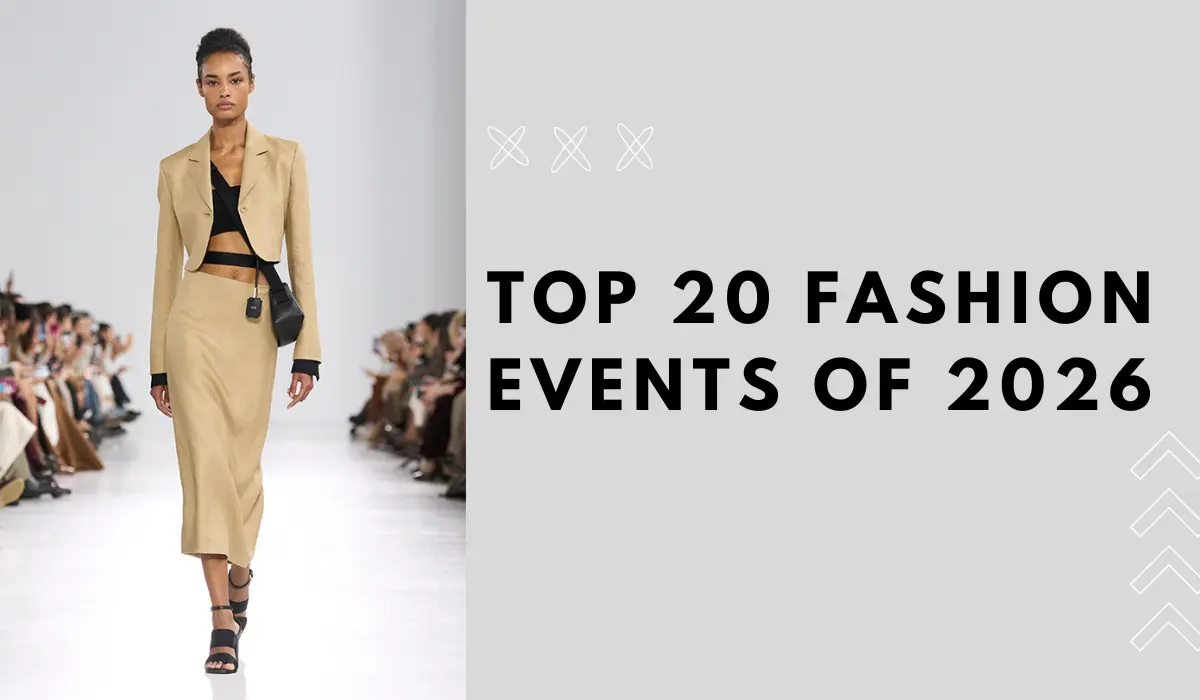
The year 2026 is redefining the global fashion landscape, and certain events are at the forefront of this transformation. This article explores the Top 20 Fashion Events of 2026 shaping the industry, analyzing their influence on trends, sustainability, innovation, and regional power distribution, while offering insights that go beyond mere visibility or celebrity presence.
The Top 20 Fashion Events Shaping 2026
The top 20 fashion events shaping 2026 are defined by their ability to influence industry decisions, not just generate visibility. This section examines events that function as global coordination platforms, shaping sustainability standards, trade relationships, regional power, and innovation adoption across the fashion ecosystem.
The events highlighted in this study are not selected for scale or celebrity presence alone. They are included because they shape outcomes, from sourcing and investment to trend validation and policy alignment. Together, these platforms form the institutional backbone of the global fashion calendar in 2026.
To reflect their functional differences, the events are grouped into five categories. Each category represents a distinct role within the industry, from global fashion weeks that set creative and commercial direction to niche and digital-first platforms that test new models of participation and governance.
Global Fashion Week Powerhouses
Global fashion week powerhouses remain influential in 2026 because they operate as agenda-setting institutions. These events consolidate creative authority, commercial validation, and media attention, shaping seasonal narratives and long-term industry priorities at a global scale.
Despite decentralization, traditional fashion capitals continue to anchor the global calendar by offering institutional legitimacy and unmatched buyer concentration. In 2026, these fashion weeks have adapted by integrating sustainability benchmarks, hybrid access, and tighter curation.
Key events in this category include:
- Paris Fashion Week (Women’s & Men’s): Remains the primary site for luxury validation, craftsmanship standards, and global trend leadership.
- Milan Fashion Week: Central to luxury manufacturing, textiles, and heritage brands, with increasing focus on traceable production.
- New York Fashion Week: A commercial-first platform influencing retail trends, brand storytelling, and American market dynamics.
- London Fashion Week: A laboratory for emerging designers, sustainability experimentation, and conceptual fashion.
- Tokyo Fashion Week: A bridge between advanced technology, street culture, and global youth-driven fashion narratives.
- Shanghai Fashion Week: A strategic gateway to the Chinese market, blending state support, manufacturing power, and design innovation.
- Seoul Fashion Week: A rapidly growing hub shaping global streetwear, beauty-fashion convergence, and pop-cultural influence.
- Copenhagen Fashion Week: A global benchmark for enforceable sustainability standards within a fashion week format.
- Dubai Fashion Week: A connector between Europe, Asia, and the Middle East, emphasizing luxury, modest fashion, and investment flows.
- Berlin Fashion Week: Increasingly influential for circular fashion, independent labels, and alternative business models.
Why these events matter in 2026:
Collectively, these fashion events define what gains legitimacy in the industry. Trends introduced here influence production cycles, retail strategies, and global media narratives. Their continued relevance lies in their ability to combine heritage, innovation, and governance, ensuring they remain central even as power disperses globally.
Business Infrastructure of the Fashion Industry
Trade and Business-first fashion events shape 2026 by driving commercial decision-making, sourcing alignment, and supply-chain restructuring. Unlike runway-led platforms, these events prioritize transactions, partnerships, and operational scale, making them indispensable to how fashion actually functions as a global industry.
While fashion weeks influence narrative and visibility, trade-focused events determine what gets produced, where, and at what scale. In 2026, these platforms are increasingly strategic, integrating sustainability compliance, digital sourcing tools, and policy engagement to meet evolving industry demands.
Key events in this category include:
- Première Vision (Paris): The most influential textile and materials fair, shaping fabric innovation, color direction, and sustainability benchmarks months ahead of production cycles.
- Pitti Immagine Uomo (Florence): A critical menswear trade platform blending commercial relevance with directional influence.
- MAGIC Las Vegas: A large-scale sourcing and buying hub connecting global manufacturers with North American retailers.
- Intertextile Shanghai Apparel Fabrics: Central to global textile sourcing, reflecting China’s manufacturing scale and innovation capacity.
- Texworld Paris: A major sourcing platform emphasizing traceability, ethical production, and material transparency.
- Micam Milano: The World’s leading footwear trade fair, influencing design, manufacturing, and retail strategies.
- Who’s Next (Paris): A bridge between emerging designers and buyers, supporting brand discovery with commercial viability.
- CIFF (Copenhagen International Fashion Fair): A hybrid platform combining trade, sustainability discourse, and Scandinavian design values.
- India International Garment Fair (IIGF): A key gateway to India’s export-oriented apparel manufacturing ecosystem.
- Sourcing at MAGIC: A focused platform connecting retailers directly with global manufacturers and suppliers.
Why these events matter in 2026:
These platforms determine how fashion moves from concept to consumer. Decisions made here influence sourcing geographies, production volumes, pricing structures, and sustainability compliance. In an era of supply-chain volatility and regulatory pressure, trade events act as risk-management and coordination tools, anchoring the industry’s commercial reality.
Platforms Defining Fashion’s Sustainable Future
Sustainability and innovation-led platforms shape fashion in 2026 by testing, validating, and scaling new industry standards. These events function as experimental and regulatory spaces where materials, production models, and technologies are evaluated before entering
Unlike traditional fashion weeks or trade fairs, sustainability and innovation-led platforms operate as proof-of-concept environments. In 2026, they are central to determining which materials, technologies, and business models are commercially viable, ethically credible, and scalable across regions.
Key events in this category include:
- Global Fashion Summit (Copenhagen): The most influential policy-aligned fashion platform, shaping global sustainability discourse and industry commitments.
- Copenhagen Fashion Week (Sustainability Framework): A leading example of enforceable sustainability criteria embedded into event participation.
- Fashion for Good Innovation Summit (Amsterdam): Focused on circularity, material science, and startup-industry collaboration.
- Neonyt (Frankfurt): A sustainability-first trade fair emphasizing ethical sourcing, traceability, and responsible consumption.
- Hyères International Festival of Fashion, Photography and Accessories: A talent-driven platform spotlighting sustainable design experimentation.
- Biofabricate Conference (Global): A cross-industry event driving innovation in bio-materials and next-generation textiles.
- Future Fabrics Expo (London): A material-centric platform influencing sustainable sourcing decisions across luxury and mass markets.
- Circular Fashion Summit (Multiple Regions): Focused on closed-loop systems, recycling technologies, and waste reduction strategies.
- Techtextil (Frankfurt): A technical textiles fair influencing performance materials, smart fabrics, and sustainable industrial applications.
- ChangeNOW Fashion & Innovation Track: A cross-sector sustainability platform connecting fashion with climate tech and policy.
Why these events matter in 2026:
These platforms act as industry laboratories, where sustainability claims are scrutinized and innovations are stress-tested. Decisions made here influence future regulations, sourcing frameworks, and investment flows. In 2026, they function as gateways between experimentation and institutional adoption, shaping how sustainability and innovation enter the mainstream fashion economy.
Emerging Economies in the Global Fashion Network
Emerging market showcases in 2026 highlight the decentralization of fashion power. These events amplify regional aesthetics, local manufacturing, ecosystems, and culturally grounded narratives that are increasingly shaping global fashion supply chains, design language, and investment interest beyond traditional Western capitals.
In 2026, emerging market fashion events are no longer peripheral. They operate as entry points into fast-growing consumer bases, alternative craft economies, and region-specific sustainability models. Global buyers and media now track these platforms to identify early-stage brands and culturally authentic innovation.
Key events in this category include:
- Lakme Fashion Week x FDCI (India): India’s most influential fashion platform, integrating craft revival, emerging designers, and global-ready commercial collections. Its 2026 editions place a stronger emphasis on sustainability, regional textiles, and international buyer engagement.
- São Paulo Fashion Week (Brazil): Latin America’s largest fashion event, known for its focus on diversity, socio-political narratives, and environmentally conscious design. In 2026, it continues to shape regional luxury and export-oriented fashion strategies.
- Shanghai Fashion Week (China): A critical platform for China’s domestic designers and global collaborations. It reflects China’s evolving consumer preferences, digital-first retail models, and increasing influence on global trend cycles.
- Arab Fashion Week (Dubai): Positioned at the intersection of luxury, modest fashion, and global retail. The event functions as a bridge between Middle Eastern designers and international fashion markets.
- Africa Fashion Week London (Pan-African Focus): A diaspora-led platform spotlighting African designers, textiles, and narratives. It plays a growing role in integrating African fashion into global trade and media ecosystems.
Why these events matter in 2026:
These showcases represent structural shifts in fashion authority. They challenge Eurocentric dominance by introducing new production hubs, aesthetics, and consumer logic. In 2026, emerging market platforms are not trend followers; they are origin points for the next phase of global fashion evolution.
Conceptual, Cultural, and Digital-First Fashion Platforms
Conceptual, cultural, and digital-first fashion platforms in 2026 expand fashion beyond physical runways. These events prioritise narrative, community, and experimentation, using digital formats, cultural programming, and alternative presentation models to influence how fashion is created, experienced, and distributed globally.
This category reflects how fashion in 2026 operates as a cultural system, not just a commercial one. These platforms attract designers, artists, technologists, and audiences interested in fashion as identity, discourse, and digital experience rather than seasonal product cycles.
Key events in this category include:
- Digital Fashion Week (Global): A fully virtual platform showcasing digital garments, NFTs, and avatar-based fashion experiences. It plays a critical role in defining fashion’s relationship with gaming, the metaverse, and virtual economies.
- Fashion Film Festival Milano: A leading cultural platform where fashion intersects with cinema and storytelling. In 2026, it continues to influence brand narratives and visual communication strategies.
- Berlin Fashion Week (Conceptual Focus): Known for its experimental formats, gender-fluid design, and sustainability-led creative direction. Berlin’s platform challenges traditional luxury aesthetics and commercial norms.
- Seoul Fashion Week (Digital-Forward Editions): While rooted in physical shows, Seoul’s digital extensions and global livestream strategies make it a leader in hybrid fashion presentation and Gen Z engagement.
- Maison&objet – Digital and Concept Sections (Paris): Expand beyond interiors into fashion-adjacent cultural programming, blending craftsmanship, conceptual design, and digital storytelling.
Why these events matter in 2026:
These platforms redefine what constitutes a fashion event. By decentralizing the runway and embracing digital-first storytelling, they influence branding, audience engagement, and creative freedom. In 2026, they function as testing grounds for fashion’s cultural relevance in an increasingly hybrid and screen-led world.
Patterns, Comparisons, and Industry Shifts
Comparing fashion events across formats and regions in 2026 reveals a clear industry realignment. Power is no longer concentrated in a few capitals or event types. Instead, influence is distributed across commercial, cultural, sustainability-led, and regional platforms, each serving distinct but interconnected functions.
Fashion Week vs Trade Shows
In 2026, fashion weeks shape cultural relevance and brand perception, while trade shows drive commercial decision-making. Fashion weeks influence trends and storytelling, whereas trade shows determine sourcing, pricing, and distribution. The most influential brands now strategically participate in both to balance visibility and revenue.
Traditional fashion weeks: Paris, Milan, London, and New York continue to dominate editorial coverage and creative leadership. However, their direct commercial impact has declined as buying cycles shift toward pre-season appointments and sourcing-focused events.
Trade shows such as Premiere Vision, Pitti Uomo, and MICAM now play a decisive role in:
- Material selection and supplier relationships
- Pricing benchmarks and order volumes
- Long-term production planning
In practice, fashion weeks create desire, while trade shows convert that desire into transactions.
Regional Performance Trends
Regional performance trends in 2026 show accelerated growth in Asia, the Middle East, and Parts of Africa, while European and North American events focus on consolidation and reinvention. Emerging regions benefit from expanding consumer markets, digital adoption, and culturally distinct fashion narratives.
Key regional shifts include:
- Asia: Shanghai and Seoul leveraging technology-driven retail and youth culture
- Middle-East: Dubai positioning itself as a luxury and modest fashion hub
- Africa: Increased visibility through diaspora-led platforms and global collaborations
Meanwhile, legacy fashion capitals invest heavily in sustainability frameworks and hybrid formats to retain relevance.
Sustainability Leadership Index
Sustainability leadership in 2026 is defined by enforcement, not messaging. Events that mandate sustainability criteria, audit participation, and align with policy frameworks outperform those relying on voluntary commitments. Copenhagen Fashion Week and Global Fashion Summit lead due to measurable accountability systems.
Key Indicators Used:
- Mandatory sustainability requirements
- Transparency in sourcing and production
- Alignment with EU and global climate frameworks
- Industry adoption beyond the event itself
High-Performing Events (Indicative):
- Copenhagen Fashion Week
- Global Fashion Summit
- Neonyt
- Fashion for Good Innovation Summit
Fashion events are no longer just about glamour or seasonal showcases. In 2026, they serve as critical industry platforms, where designers, buyers, manufacturers, media, and policymakers converge to make decisions that shape global trends and market behavior. These events influence everything from sourcing strategies and regional growth to sustainability standards and technological adoption.
What sets 2026 apart is the consolidation of hybrid formats and the integration of sustainability metrics into event operations. Events now function as structured environments where claims about eco-friendly materials, innovative production techniques, and social responsibility are verified and compared. Unlike the purely digital platforms of the past, physical and hybrid gatherings provide the trust and accountability that the industry requires.
This article examines 20 influential events across different categories: global fashion weeks, trade and business-first shows, sustainability-focused platforms, emerging market showcases, and niche or digital-first events.
Each event is evaluated not just for scale or media coverage, but for its impact on industry decisions, regional influence, and long-term trends, providing a comprehensive guide for professionals, creatives, and analysts who want to understand how fashion in 2026 is being shaped.
Over the last decade, the fashion industry has undergone profound transformation. Digital platforms, AI-driven trend forecasting, and social media have accelerated visibility, but they cannot replace the strategic function of events.
In 2026, fashion events act as arenas where industry priorities are negotiated, relationships are solidified, and market credibility is determined.
Sustainability has become a baseline requirement, not an optional consideration. Brands and manufacturers are increasingly evaluated on measurable environmental and social criteria during these events.
Likewise, hybrid event formats allow broader participation without sacrificing the trust-building and accountability that in-person interactions provide.
Additionally, these events highlight regional dynamics in global fashion. Emerging markets such as Lagos, Mumbai, São Paulo, and Seoul now host platforms that shape local production, regional influence, and international investment decisions.
The opening narrative sets the stage for understanding why the top 20 events of 2026 matter, not just for trend visibility, but for their structural impact on the fashion ecosystem.
In 2026, fashion events are more than showcases; they are industry engines that shape sustainability practices, technological adoption, and regional influence.
The top 20 events highlighted in this article are not just trend-setting; they are decision-making hubs where commercial priorities, creative direction, and ethical standards intersect, defining the course of global fashion.
The fashion industry has reached a point where visibility alone is insufficient. While social media and digital platforms spread trends rapidly, the real impact lies in events that consolidate influence and authority.
Designers, buyers, and industry leaders rely on these platforms to evaluate innovation, verify sustainability claims, and determine which trends and practices gain long-term traction.
Events in 2026 are strategically significant. Hybrid and physical formats ensure wide participation while maintaining the credibility and trust necessary for high-stakes decision-making.
These events and gatherings also act as platforms for emerging regions to assert influence, allowing markets outside traditional hubs like Paris, Milan, and New York to shape global sourcing, investment, and trend adoption.
By analyzing the top 20 events, this article highlights how structured gatherings, not just digital visibility, drive the future of fashion.
Each fashion event is assessed for its industry relevance, market impact, and role in shaping trends, sustainability practices, and regional power dynamics, giving professionals a roadmap to understand which platforms truly matter in 2026.
Why Fashion Events Still Matter in 2026
Fashion events continue to be central in 2026 because they are decision-making hubs, not just showcases. They influence sustainability compliance, regional influence, sourcing choices, and industry credibility in ways digital platforms alone cannot replicate, ensuring that trends, materials, and practices are adopted systematically across the global fashion ecosystem.
While digital platforms accelerate trend visibility, they cannot replace the strategic, high-stakes coordination that occurs at fashion events. In 2026, events serve as concentrated arenas where designers, manufacturers, buyers, media, and policymakers come together to evaluate innovations, verify sustainability claims, and set industry standards.
These gatherings also provide trust and accountability. Sustainability metrics, innovative materials, and production practices are collectively scrutinized, allowing stakeholders to identify which trends are credible and scalable.
This function is particularly critical in emerging markets, where regional events allow local designers and manufacturers to gain global recognition and influence.
Moreover, events act as long-term trend validators. Decisions made within these spaces shape production cycles, sourcing agreements, and market positioning months in advance, establishing them as structural pillars of the fashion ecosystem rather than ephemeral cultural spectacles.
In short, fashion events in 2026 still matter because they provide what digital channels cannot: a platform for coordination, validation, and the enforcement of industry-wide standards that influence both creative and commercial outcomes.
Why 2026 Marks a Watershed Moment
2026 is a watershed year because fashion events have shifted from experimental adaptation to institutionalized infrastructure. Hybrid participation, sustainability standards, and regional diversification are now embedded into event operations, making these gatherings critical for strategic industry decision-making and long-term trend validation.
Previous years saw fashion events experimenting with digital formats, sustainability initiatives, and regional expansion. By 2026, these features will have become standard operating principles.
Hybrid formats allow global participation without compromising in-person trust, while sustainability metrics are systematically integrated into programming, judging criteria, and exhibitor evaluation.
This year also marks a shift in regional influence. Emerging markets like India, Brazil, and South Korea now host events that attract international buyers, media, and policymakers, challenging traditional hubs such as Paris, Milan, and New York.
The influence of these platforms is not superficial; it shapes sourcing decisions, investment flows, and trend adoption globally.
From a structural perspective, 2026 reflects a turning point where fashion events are embedded into governance mechanisms rather than being optional marketing tools. They act as coordination systems, ensuring that innovation, ethics, and market dynamics align across a fragmented global fashion landscape.
Purpose, Scope, and Direction of the Study
The purpose of this study is to evaluate the top 20 fashion events of 2026 as structural industry platforms. It examines their influence on trends, sustainability, regional power, and innovation, providing actionable insights for designers, brands, policymakers, and analysts navigating a rapidly evolving global fashion ecosystem.
This study goes beyond ranking events by visibility or celebrity presence. Its aim is to understand how events shape the industry, from sourcing and sustainability decisions to market positioning and regional influence.
By analyzing different types of events, global fashion weeks, trade-focused shows, sustainability-led platforms, and emerging market showcases, the study provides a comprehensive understanding of industry dynamics in 2026.
The scope is carefully defined: only events with measurable influence on industry decisions, multi-stakeholder participation, and continuity are included. Brand-only showcases, influencer-driven activations, and consumer-focused pop-ups are excluded, as they do not significantly impact structural decision-making.
Directionally, the study adopts a comparative and analytical lens, identifying patterns across event types, regions, and governance structures. It emphasizes long-term consequences rather than ephemeral trends, highlighting which platforms truly shape global fashion in 2026 and beyond.
Focus and Boundaries
This study focuses on fashion events that exert sustained influence on industry practice, sustainability, and regional power in 2026. It excludes consumer-facing spectacles and brand-only activations, concentrating on events that serve as institutional platforms within the global fashion ecosystem.
The analysis prioritizes events that demonstrate structural impact rather than temporary visibility. Qualifying events are those that influence sourcing decisions, establish or reinforce sustainability standards, drive technological adoption, or shape professional norms across regions.
Events limited to marketing, entertainment, or influencer-driven exposure are excluded, ensuring that the study remains focused on platforms that genuinely coordinate industry behavior. This includes physical, hybrid, and digital-first events that involve designers, buyers, manufacturers, policymakers, and trade bodies.
By clearly defining focus and boundaries, the study ensures comparability and analytical rigor, providing a roadmap for understanding which events are influential in shaping global fashion dynamics and why they matter strategically in 2026.
Goals of the Analysis
The goal of this analysis is to identify how the top 20 fashion events in 2026 operate as strategic platforms for industry alignment, innovation diffusion, and sustainability enforcement, providing insights beyond mere trend visibility.
The study aims to:
- Map power centers within the global fashion event ecosystem.
- Assess how different event formats, fashion weeks, trade shows, and sustainability-focused platforms affect decision-making and professional behavior.
- Evaluate which platforms drive measurable industry change, including adoption of sustainable practices, regional influence, and technological integration.
- Compare regional and global patterns, identifying shifts in market dominance and emerging hubs.
By achieving these goals, the analysis provides actionable intelligence for designers, brands, investors, policymakers, and media professionals. It highlights which events shape real-world outcomes, rather than just generating social media buzz or ephemeral trend visibility, positioning 2026 as a pivotal year in the evolution of the fashion industry.
The Argument at the Core of this Analysis
The central argument of this study is that fashion events in 2026 function as structural industry platforms, shaping sustainability practices, regional influence, and innovation adoption, rather than acting solely as promotional showcases. Their value lies in coordinating decisions that define long-term trends, market positioning, and governance standards.
This study posits that the top 20 events of 2026 are decision-making hubs rather than mere spectacles. Designers, buyers, manufacturers, policymakers, and media use these platforms to validate innovations, enforce sustainability benchmarks, and allocate resources strategically. Events that integrate hybrid participation, sustainability metrics, and cross-regional collaboration emerge as the most influential.
The thesis emphasizes that 2026 is a turning point where fashion events have become embedded in the structural framework of the industry. They are no longer optional or purely promotional; they shape outcomes, including sourcing decisions, investment flows, and professional standards.
By focusing on events that deliver tangible influence, the study demonstrates how industry coordination, rather than social visibility, drives the evolution of global fashion in 2026.
Research Approach and Analytical Method
This study used a mixed-method research approach, combining qualitative industry analysis with comparative event mapping. The methodology emphasizes verification, cross-referencing, and contextual evaluation to ensure accuracy, relevance, and actionable insight into the top 20 fashion events shaping 2026.
Research was conducted using multiple sources to ensure robustness and reliability. Primary sources included official event reports, exhibitor lists, and documentation from leading fashion councils such as the CFDA, BFC, and Fédération de la Haute Couture et de la Mode (FHCM).
Secondary sources included industry publications, trade analyses, sustainability frameworks, and policy briefs from organizations such as the Global Fashion Agenda and the Ellen MacArthur Foundation.
Each event was analyzed for continuity, stakeholder diversity, and documented industry influence, rather than simply media coverage or celebrity presence. Observations from panels, interviews, and on-ground participation were incorporated to validate insights.
Contradictions between sources were resolved by prioritizing primary data and policy-linked organizations, ensuring conclusions reflect operational reality rather than promotional narratives.
This methodological rigor allows the study to provide actionable insights about the structural role of fashion events in 2026, highlighting which platforms drive real-world decisions and trends in the global fashion ecosystem.
Data Sources and Industry References
The study relies on verified, authoritative sources, including fashion councils, trade reports, sustainability frameworks, and primary event documentation to ensure reliability and credibility. Cross-referencing multiple high-authority sources ensures that findings accurately reflect the influence of the top 20 fashion events in 2026.
Primary sources include publications and datasets from:
- Council of Fashion Designers of America (CFDA)
- British Fashion Council (BFC)
- Fédération de la Haute Couture et de la Mode (FHCM)
- Global Fashion Agenda
- Ellen MacArthur Foundation
- McKinsey’s State of Fashion reports
Secondary sources include official trade fair documentation, exhibitor lists, sustainability disclosures, and regional policy briefs from EU and emerging market cultural and economic bodies. Observations from on-ground participation, panel discussions, and industry interviews provided qualitative insights, supplementing quantitative data.
Event Selection Criteria
Events were selected based on their measurable industry impact, multi-stakeholder participation, and continuity. The focus is on platforms that influence sourcing, sustainability, and professional norms, rather than those driven solely by marketing or entertainment.
To ensure analytical rigor, each event included in the top 20 list had to meet specific criteria:
- Sustained operation: Active for multiple years with consistent industry participation.
- Multi-stakeholder engagement: Participation from designers, buyers, manufacturers, media, and policymakers.
- Documented influence: Evidence of shaping sourcing decisions, trend adoption, or sustainability practices.
- Innovation or sustainability integration: Inclusion of new materials, technologies, or sustainability benchmarks.
Events were excluded if they were primarily brand-centric, consumer-focused, or influencer-driven, as these do not significantly impact structural industry decision-making. By applying these criteria, the study highlights events that actively shape the global fashion ecosystem in 2026, rather than those that only generate ephemeral attention.
Verification and Cross-Checking Process
All findings were validated through multi-source cross-checking to ensure accuracy and reduce bias. Primary event documentation, sustainability frameworks, trade participation records, and policy-linked sources were compared and verified to ensure conclusions reflect operational reality rather than promotional narratives.
To guarantee reliability, every event included in the study underwent a rigorous verification process:
- Primary documentation: Official event schedules, exhibitor lists, and reports were reviewed.
- Cross-referencing: Information was compared with trade analyses, sustainability reports, and policy briefs from authoritative organizations.
- Secondary validation: Media coverage, panel discussions, and interviews with industry professionals were used to corroborate claims.
- Conflict resolution: In cases of contradictory data, priority was given to primary sources and verified council or organizational reports.
This process ensures that the study’s conclusions are trustworthy, actionable, and grounded in real-world industry practices, providing a solid foundation for analyzing the structural influence of the top 20 fashion events of 2026.
Fashion in 2026: The Bigger Picture
In 2026, fashion operates within a landscape shaped by sustainability, technology, and regional diversification. Industry decisions are increasingly influenced by regulations, supply-chain dynamics, and hybrid event formats, positioning fashion events as critical coordination points rather than merely promotional platforms.
The global fashion ecosystem in 2026 reflects structural transformation. Sustainability has become a baseline requirement, with brands and events evaluated on measurable environmental and social metrics. Technology, including AI-driven design, virtual showrooms, and hybrid event participation, allows broader access while maintaining accountability.
Geopolitical and economic factors now directly influence sourcing, production, and market reach. Regional hubs, including Seoul, Lagos, São Paulo, and Mumbai, have gained prominence, hosting events that attract international buyers, media, and policymakers. These shifts demonstrate that regional influence now complements traditional power centers like Paris, Milan, and New York.
Fashion events in this context are decision-making hubs, coordinating industry behavior, validating sustainability practices, and shaping technological adoption. They have evolved from cultural showcases into essential nodes in the structural network of global fashion, making their study critical for understanding trends and operating strategy in 2026.
Sustainability as the New Baseline
By 2026, sustainability is no longer optional but a mandatory baseline for fashion events. Top platforms integrate environmental and social metrics into operations, judging, and exhibitor requirements, influencing sourcing, production practices, and industry-wide adoption of ethical standards.
Sustainability has moved from aspirational to institutionalized in the fashion industry. Events now enforce eco-friendly practices through:
- Material verification: Ensuring fabrics and components meet environmental standards.
- Supply chain accountability: Evaluating brand’s sourcing and production processes.
- Energy and waste management: Mandating sustainable logistics and event operations.
Platforms such as Global Fashion Agenda collaborations, sustainability-focused trade shows, and specialized innovation events serve as benchmarks for industry-wide adoption. Stakeholders rely on these events to assess which practices are scalable, credible, and aligned with regulatory frameworks.
By embedding sustainability into core operations, 2026 events influence long-term behavior, ensuring that fashion decisions are both commercially viable and environmentally responsible. This shift demonstrates how events have become regulatory and strategic platforms, shaping the industry beyond trend visibility.
Technology and Hybrid Event Formats
In 2026, technology and hybrid event formats are core to fashion events’ influence. Virtual participation, AI-driven showcases, and digital trade tools expand access, enable real-time data collection, and reinforce credibility, allowing events to function as strategic platforms rather than purely social spectacles.
Hybrid and technology-driven formats have transformed how fashion events operate. While physical presence remains essential for trust and networking, virtual participation allows global accessibility for buyers, media, and policymakers, including those who cannot travel. AI tools now assist in trend forecasting, digital showrooms, and predictive analytics, enabling stakeholders to make informed sourcing and investment decisions.
Digital engagement platforms also allow for data-driven evaluation of exhibitor performance, attendee behavior, and trend uptake, providing quantifiable metrics that inform future production and event planning. Virtual reality and 3D runway experiences complement physical shows, creating immersive, interactive platforms that combine visibility with operational decision-making.
These technological integrations ensure that fashion events in 2026 are efficient, accountable, and strategically significant, reinforcing their role as hubs of industry coordination and innovation rather than mere promotional showcases.
Geopolitical and Economic Influences
Geopolitical tensions, trade policies, and economic realignments significantly shape fashion events in 2026. These forces influence sourcing strategies, regional participation, and investment priorities, positioning major fashion events as strategic forums where global uncertainties are assessed and navigated collectively.
In 2026, fashion does not operate in isolation from global politics or economic pressures. Trade restrictions, shifting tariffs, labor regulations, and regional conflicts directly affect supply chains and production timelines. Fashion events increasingly reflect these realities, with exhibitors and buyers using them to reassess sourcing locations, diversify suppliers, and manage risk.
Economic factors such as inflation, currency volatility, and uneven post-pandemic recovery have also altered participation patterns. Brands are more selective about which events they attend, favoring platforms that offer clear commercial outcomes and policy relevance. As a result, events that facilitate cross-border dialogue, government participation, or trade-body involvement have gained influence.
These geopolitical and economic pressures elevate fashion events from creative gatherings to strategic negotiation spaces, when industry stakeholders interpret global shifts and adapt their operational strategies accordingly.
Emerging Regional Voices
In 2026, emerging regional fashion events play a decisive role in reshaping global influence. Platforms in Asia, Latin America, and the Middle East now act as gateways for new talent, production networks, and cultural narratives, challenging the long-standing dominance of traditional Western fashion capitals.
The global fashion landscape in 2026 is increasingly multi-polar. Cities such as Mumbai, Lagos, Seoul, São Paulo, and Dubai host events that are no longer positioned as peripheral or “alternative” but as strategic industry platforms. These events attract international buyers, media, and investors seeking access to new markets, skilled labor, and region-specific aesthetics.
What distinguishes these regional platforms is their integration of local manufacturing ecosystems with global trade networks. Many emerging market events actively connect designers with textile producers, artisans, and export councils, enabling faster translation from runway to retail. This has shifted how global brands approach sourcing and collaboration.
Additionally, these events offer cultural and narrative depth that resonates with contemporary consumers seeking authenticity and traceability. By foregrounding regional identity alongside commercial viability, emerging fashion events in 2026 contributes meaningfully to the redistribution of creative and economic power within the global fashion industry.
Trend Summary Table
The following table summarizes the dominant forces shaping events in 2026, highlighting how sustainability, technology, regional diversification, and economic pressures intersect across platforms. This overview provides a quick, comparable snapshot of macro trends influencing event design, participation, and industry impact.
Trend Summary Table (2026)
| Key Trend | Description | Impact on Fashion Events |
| Sustainability as Baseline | Environmental and social standards embedded into event operations | Exhibitor eligibility tied to measurable sustainability metrics |
| Hybrid Event Models | Integration of physical and digital participation | Broader global access without loss of credibility |
| Regional Power Shift | Growth of Non-Western fashion hubs | Increased buyer and investor attention to emerging markets |
| Tech-driven Decision-making | AI, digital showrooms, and data analytics | Faster sourcing, trend validation, and scalability |
| Geopolitical Sensitivity | Trade policy and economic uncertainty | Events used for risk assessment and sourcing diversification |
This table distills the recurring patterns identified across the top 20 fashion events of 2026. Rather than operating independently, these trends reinforce one another, shaping how events are structured and why certain platforms gain influence.
Sustainability and technology now function as entry requirements, not differentiators. Regional diversification reflects broader economic and geopolitical realities, while hybrid formats ensure resilience and inclusivity. Together, these forces explain why some events have become strategic industry infrastructure, while others struggle to remain relevant.
Why 2026 Will Be Remembered as a Turning Point
2026 marks a turning point because fashion events now operate as systems of influence, not isolated spectacles. Sustainability frameworks are enforceable, emerging regions hold measurable power, and digital formats coexist with physical events. This convergence fundamentally reshapes how fashion authority is created and sustained.
In my experience working with fashion and media professionals, 2026 stands out as the year when intent replaced traditions. Brands no longer attend events for legacy value alone. Participation is now guided by:
- Market access and sourcing needs
- Sustainability compliance
- Audience alignment
- Cultural positioning
Events that failed to adapt lost relevance, while adaptive platforms gained long-term credibility.
Strategic Takeaways for Industry Stakeholders
For Brands and Designers:
- Align event participation with clear business objectives.
- Balance cultural visibility with commercial platforms
- Prioritise events with enforceable sustainability standards
For Media and Analyst:
- Track influence beyond traditional fashion weeks
- Evaluate events by outcomes, not attendance size
For Investors and Policymakers:
- Monitor innovation-led platforms for scalable solutions
- Support regional ecosystems driving decentralized growth
Conclusion: The Top 20 Fashion Events Defining 2026
In 2026, fashion events no longer operate as isolated calendar highlights. They function as interconnected systems that shape how fashion is produced, communicated, regulated, and consumed. The top 20 fashion events of 2026 collectively illustrate an industry that has moved beyond spectacle toward strategy, accountability, and regional balance.
What distinguishes this year is not the emergence of entirely new formats, but the maturity of intent behind existing ones. Global fashion weeks continue to set cultural direction, trade platforms drive commercial infrastructure, sustainability-led forums establish enforceable standards, and emerging market showcases introduce new centers of influence. Each category plays a specific role within a wider ecosystem rather than competing for the same form of relevance.
From an industry perspective, 2026 will be remembered as the moment when participation became purposeful. Brands, designers, and stakeholders increasingly evaluate fashion events based on measurable outcomes: market access, sustainability compliance, supply-chain alignment, and audience relevance, rather than legacy value alone.
For media, investors, and policymakers, these events offer more than trend forecasting. They provide early signals of where fashion authority is shifting, which markets are consolidating power, and how innovation is moving from experimentation to implementation.
Taken together, the top 20 fashion events shaping 2026 mark a clear transition: fashion is no longer organized around a single hierarchy or geography. Instead, it operates through a network of platforms that reflect a more distributed, accountable, and globally responsive industry.
Reference:
- Business of Fashion (BoF)
- Industry analysis, fashion weeks, trade shows, sustainability, and global market shifts.
- https://www.businessoffashion.com
- Global Fashion Agenda (GFA)
- Research on sustainability, circular fashion, and policy-aligned fashion frameworks.
- https://www.globalfashionagenda.com
- Copenhagen Fashion Week – Sustainability Framework
- Official sustainability criteria and enforcement model for fashion events.
- https://copenhagenfashionweek.com/sustainability
- Fashion for Good
- Innovation platform focusing on circular materials, supply chains, and fashion tech.
- https://fashionforgood.com
- European Commission – Circular Economy Action Plan
- Policy reference for sustainability and textile regulations impacting fashion events.
- https://environment.ec.europa.eu/strategy/circular-economy-action-plan_en
- Première Vision Paris (Official Website)
- Trade-focused insights on materials, sourcing, and global fashion supply chains.
- https://www.premierevision.com
- Pitti Immagine (Pitti Uomo)
- Menswear trade and cultural influence reference.
- https://www.pittimmagine.com
- Shanghai Fashion Week (Official Platform)
- Regional fashion ecosystem and Asia-focused market evolution.
- https://www.shanghaifashionweek.com
- Lakmé Fashion Week x FDCI
- Indian fashion industry, emerging designers, and craft integration.
- https://lakmefashionweek.co.in