
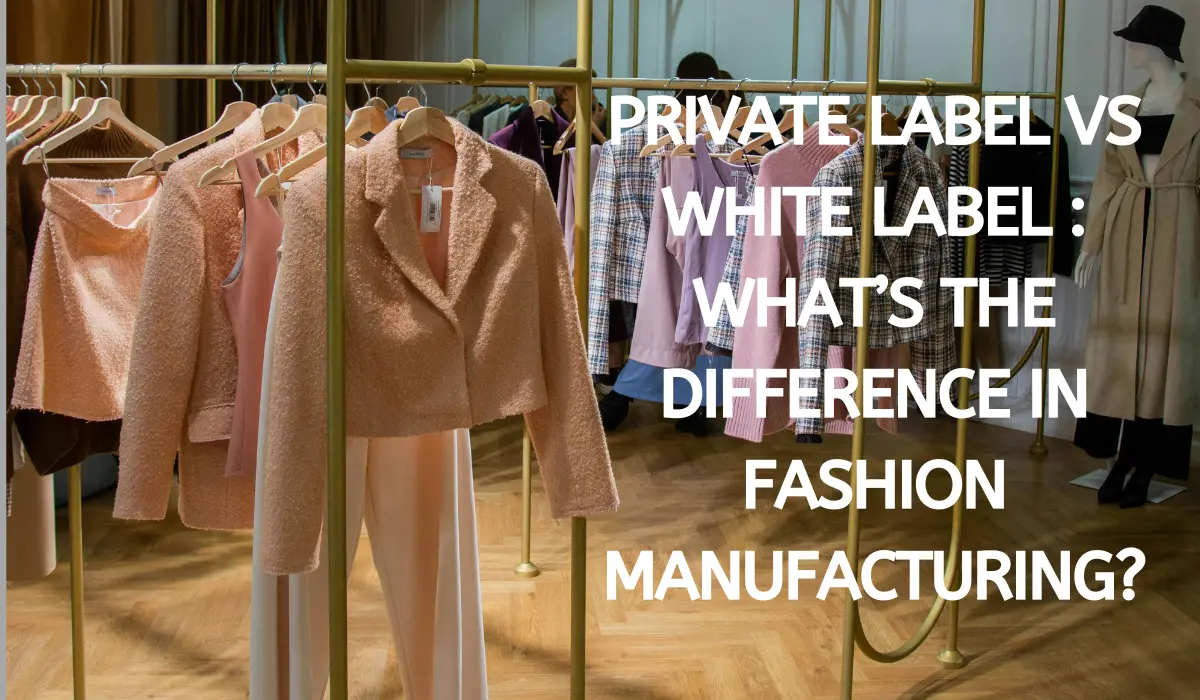
Regarding emerging trends in fashion manufacturing and building brand identity and a sustainable business, the differences between private label and white label production come into play. The core and fundamental differences between the two terms lie in the level of control, customization, cost, and scalability.
With a private label, you have the opportunity to create your brand’s exclusive and private collection of style attributes, which include fabrics and fits, down to the packaging. This is a great option for start-up businesses and also for well-established companies that are looking to gain a competitive edge in establishing a brand identity.
Differences from the former is that in white label manufacturing, you center your attention to products that are pre-designed. That means you are looking to get products that are ready to be marked and sold with your brand. This option offers lower expenditures and quicker market entry.
The differences in business model resources and strategies will also come from the long-term goals and the market. Are you pitching a fashion house identity, or are you looking to splash and create a business with lower market entry costs and other business model resources?
The differences in business model resources and strategies will also come from the long-term goals and the market. Are you pitching a fashion house identity, or are you looking to splash and create a business with lower market entry costs? This is what Hula Global is aiming for with the guide.
Emerging Trends in Fashion Manufacturing: Building Identity Through Smarter Production Models
The global fashion industry is currently redefining itself to meet sustainability objectives, taking on digital innovations, and responding to growing consumer expectations around transparency and individuality. New entrants to the industry compete on more than just thoughtful design; they are competing on the aspects of purpose, personalization, and process. The need to choose between private label and white label has become a core business decision, rather than just a simple sourcing choice.
Contemporary customers are looking for more than a simple product. A private label approach to fashion allows brands to showcase their creativity and diversity not just in design, but in materials and narratives. This is especially relevant for the slow fashion movement.
The business of white-label manufacturing is adapting to a data-informed, rapid-response paradigm of production, empowering business owners to iterate on an idea, get real-time feedback, and expand in a well-informed manner.
Information technology and automated systems are making manufacturing processes such as AI design forecasting, 3D prototyping, and on-demand production more efficient. The low-MOQ customization frameworks are revolutionizing the market.
In the age of fashion manufacturing, the choice is certainly not between private and white-label systems. The core values of flexibility, ethical manufacturing practices, and brand identity can be seamlessly integrated in any path you choose.
Defining Private Label and White Label in Fashion
In Fashion manufacturing, Private Label and White Label are two common terms that are often misunderstood. Although both allow brands to sell products under their own name, they vary in control, customization, and brand identity.
A brand employing private-label manufacturing means the brand gets exclusivity. The Private Label brand gets to design, develop, and produce the product according to its own specialized preferential guidelines. For Private
Label brands, they choose all the design element specifics needed, including fabrics, trims, and fit. The manufacturer then brings their vision to life. This model works exceptionally well for brands that wish to have full creative control, especially in differentiating their brand, as all the products are uniquely geared toward them!
Compared to Private Label, White Label means the brand gets no customization or control. A manufacturer that creates multiple products to sell uses White Label, which means unbranded portions of their stock. The manufacturer determines the design that can be altered and sells it for their own profit.
The retailer simply buys the completed garments, which they can then brand. This is a quicker way of entering a customer, especially a tested product category, which is also lower in cost.
In brief: Private Label = Customization, control, exclusivity
White Label = Speed, affordability, simplicity
Considering the value each model has for the brand may explain the differences in each model’s value for the brand. Each model certainly has its advantages. Model selection is thus dependent on your brand’s vision, brand’s time, and ultimately, your brand’s goals.
Cost and Branding Differences
The value differences associated with each model explain the differences as far as investments and ownership are concerned. There is always the time value of money principle.
The higher the investment in Private Labeling, of which the investment fully pays for exclusivity and customization, the greater the brand’s ownership value. In this model, the brand invests in design development, sampling, pattern making, and bespoke production.
In time, with larger investments, value and control expand proportionately. Control extends as the brand completes the development cycle, which includes the selection of various components, right down to the packaging. With higher perceived value, control, and profitability, the brand is strengthened in storytelling and differentiation when compared to the competition.
The White Labeling model, on the other hand, has lower control and greater value in time and cost. There is no development cycle since the brand selects from existing catalogs and only attaches its logo. There is no cost control, and thus no spending control, which is ideal for brands testing other markets and levels. Lastly, there is low differentiation as all competition has the same product with only the logo changed.
From a long-term valuation perspective, Private Label creates long-term equity while White Labelling focuses on speed and cost efficiency. For rapid market entry, Startups initially leverage White Labelling and pivot to Private Label as they grow and solidify their brand DNA.
Long-Term Scalability: Pros and Cons
From the perspective of long-term growth and sustainability, comparing Private Label and White Label manufacturing options comes down to how you predict scaling your business.
With Private Label, the long-term design and growth of your brand is the most sustainable because you cultivate brand equity around your unique, private designs. As your sales begin to grow, production will be able to scale and readily cater to your demand exclusivity.
After controlling the margins and having the power of premium pricing, you will be able to fully own and control your patterns, designs, and sourcing options. This, of course, comes with the potential downside of requiring more significant upfront investments, extended lead times, and ongoing collaborative relationships with your manufacturing partners.
With White Label, you have maximum volume scalability, but the design and branding remain secondary. It is difficult to differentiate yourself in the competition, and while it is more inexpensive and readily available to restock, you risk being perceived as purely generic. This perception of being a generic brand uncaps your long-term growth potential.
For this reason, White Label is strategically utilized by many marketers and brands to provide product variability and streamlining cash flow, as they gradually shift the core collection toward Private Label, which in turn reinforces brand identity.
Flexibility, differentiation, and ownership will be yours in Private Label, while speed and convenience will come with White Label. This is why the most effective approach often involves a combination of both models, changing with your brand’s maturity and growth.
Conclusion: Build Your Brand, Your Way
In fashion manufacturing, whether you choose Private Label or White Label, there is, strictly speaking, no better option. The decision centers on which best suits your current business stage, creative ambitions, and growth plan.
If you wish to establish a distinct brand and want to control every design aspect, Private Label manufacturing through Hula Global is your best option, in which case, you will have creative latitude, exclusivity, and scalability necessary for prolonged success. You will be able to design products that speak your story, embody your values, and cater to your audience, with world-class and ethically sourced manufacturing at every level.
If your goal, however, is to gain rapid market access, test trends, or diversify your business, White Label is also a viable option because it is designed with minimal investment and increased efficiency in mind. It allows for agile movement, lowers risk, and provides a means to test your ideas before you pivot to your own Private Label line.
The best brands tend to find a balance, starting simple, strategically scaling, and refining their design DNA over time.
You can find that balance with Hula Global’s dual expertise. You can simplify the paradoxes that come with modern fashion manufacturing, all the while honoring your brand vision.
Programs
- If you are exploring the idea of starting a fashion brand – Join the Masterclass
- If you are 100% sure of launching a clothing brand or are in the process of launching a clothing brand – Join the Bootcamp
- If you are looking for low MOQ supplier, inquire about the Co-pilot program.
- If you have a private label brand and you are looking to scale up – Join our Private Label Program.
- If you are looking for surplus & Liquidation deals – join our liquidation program.
- If you are not sure about joining the bootcamp, – Join the Masterclass to get a feel of what Bootcamp has to offer and if you still have questions, you can email us at hello@hulaglobal.com