

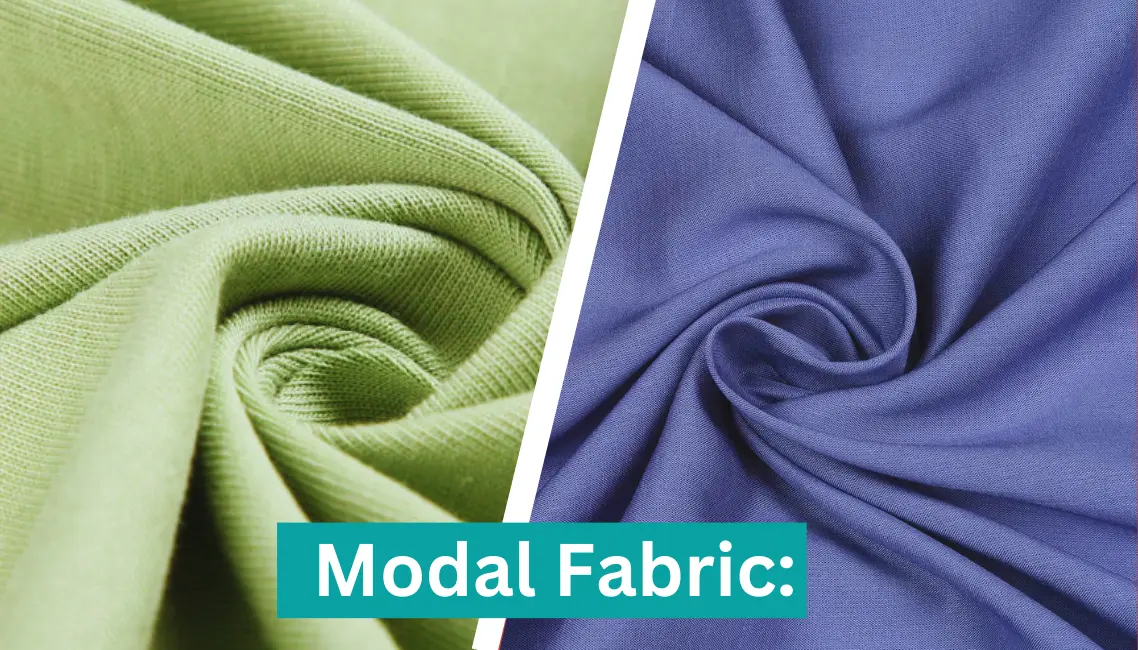
What is Modal Fabric
Modal fabric is considered one of the best fabrics available today and is a semi-synthetic, plant-based fabric made from the pulping of beechwood. It’s extraordinarily soft and breathable. It also flows nicely and is considered a “luxury rayon”.
It is part of a large family of regenerated cellulose fibers, but is considered superior to the others because of its higher strength, smoother surface, and greater resistance to shrinking.
It is also moisture-wicking, which is why it is used in various everyday essential products.
Items like T-shirts, lounge pants, underwear, active-wear, and bed sheets are items that often use the fabric to great success. Premium versions like Lenzing Modal are becoming increasingly popular in sustainable fashion and luxury apparel manufacturing.
It also holds up well to dying and retains its color well, even over time. The breathable fabric can also thermo-regulate, making it comfortable to wear in a variety of climates. Discussions around modal fabric vs cotton often focus on softness, durability, breathability, and sustainability.
The fabric is lightweight and soft, but also durable. Many brands upgrade cotton and regular rayon products to modal because it lasts longer and has a smoother feel. Today, modal clothing fabric is widely used in premium fashion and lifestyle products because of its soft and luxurious feel.
There are many fabrics available that provide a premium, luxe end product; however, few are as sustainable as modal. This reputation has made Modal a product of choice for many modern consumers.
History of Modal Fabric
Rayon technology advanced by the 1950s and was first developed in Japan. While rayon had been developed in the early 20th century with the vision of mimicking the feel of cotton and other comfortable textiles, it had shortcomings, such as significant shrinkage and low strength when the fabric was wet.
Modal was a significant improvement over rayon, keeping the softness and nice drape of rayon, but engineered to not have such weaknesses. It’s not the cotton-like, comfortable drape, pretty fabric that rayon was, but it keeps its integrity overuse and washing.
European fabric producers adopted new Modal and fabrics, finishing their established environment in the 60s.
It’s Dependably educational Mical fabric was sur, mjhkjhkjhhjkhjdeveloped sports and activities, moving and washing developed: leggings, lingerie, and high-use home textiles developed with the fabric.
Its silky feel was easily a top choice. Its overall availability in sports and at home, and overall everyday usability were winning features.
Modal has a long history of evolving from rayon, and so the new fabrics keep the precious cotton alternatives, and it’s silky and drape.
Modal represents the first significant step of finished fabrics reflecting the industry’s overall history, and it’s done in a contemporary way, also integrating sports to develop a top-quality modern feel.
Manufacturing Process of Modal Fabric
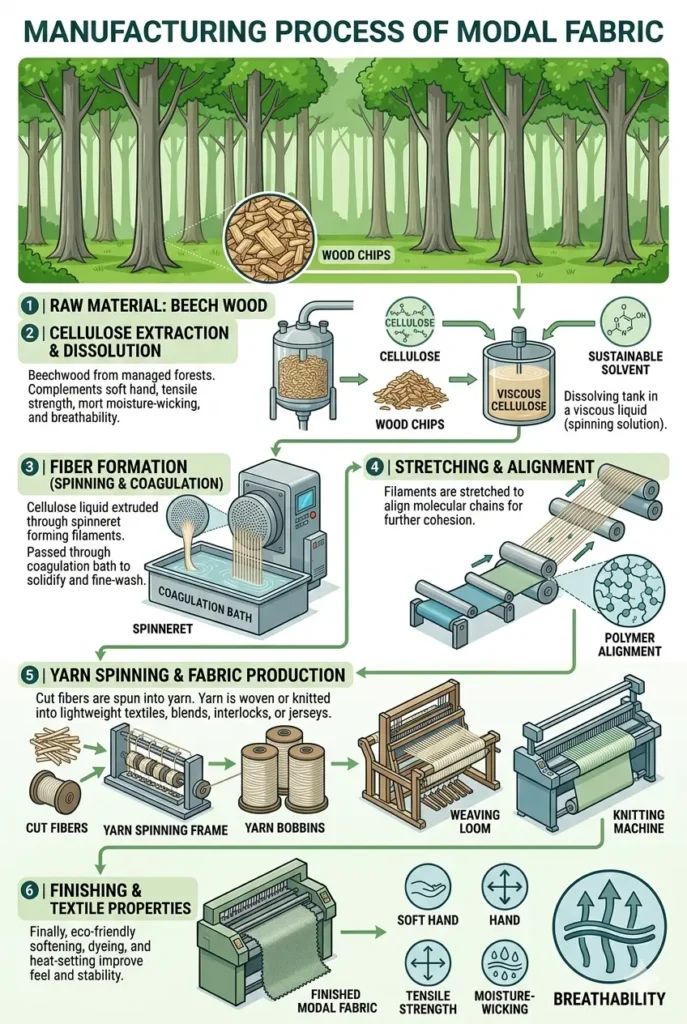
Modal fabric production begins with the wood from beech trees, a fast-growing species harvested from managed forests, as beech complements the fabric’s soft hand, tensile strength, moisture-wicking properties, and breathability.
Beechwood is processed, and the cellulose, a natural polymer extracted from wood, is converted to a sustainable solvent. This cellulose is dissolved to form a viscous liquid.
The cellulose is extruded into liquid form and, by passing the liquid through a spinneret, continuous cellulose filaments are formed.
Once the filaments are removed from the spinneret, they are passed through a coagulation bath to form a solid and to fine-wash the filaments. For further cohesion, the filaments are stretched, and molecular chains are aligned.
The cut fibers are spun and processed, the yarn is woven into lightweight and blended textiles, or into smooth interlocks and jerseys to create finished fabric. Finally, eco-friendly softening, dyeing, and heat-setting are used to finish the fabric, improving the overall feel and stability.
The closed-loop production methods used in Lenzing Modal manufacturing help reduce chemical waste and improve sustainability.
Properties & Characteristics of Modal Fabric
Modal fabric is known for its luxurious feel and performance capabilities. Its unique structure and cellulose composition enhance the comfort, durability, and beauty of various fabrics.
1. Additional Comfort
The ultra-smooth surface of modal fibres feels wonderful against the skin. It provides a wonderful, natural, and silk-like finish, making it perfect for everyday essentials such as underwear, sleepwear, and more high-end casualwear.
2. High Moisture Retention
Modal fabric absorbs moisture more than your typical cotton and helps keep the skin dry and comfortable. This helps the fabric’s breathability and is perfect for the more active parts of your day.
When comparing modal fabric vs cotton, modal absorbs moisture more efficiently, dries faster, and offers a silkier texture for everyday comfort.
3. Exceptional Flexibility
Flexible and fine fibres afford modal the ability to drape beautifully and mimic the body’s natural movement. This is ideal for a polished silhouette in dresses and fluid lines in tops or loungewear.
4. Exceptional Color Retention
Deep and uniform dying is characteristic of modal, and it helps the material keep a premium look through fading and vibrant colors in long-term use and frequent washes.
5. Little Movement
The strong chain-like structure of modal helps it keep its shape, therefore altering its shape and structure less through multiple uses. The smooth texture of modal clothing fabric makes it ideal for sensitive skin and high-comfort garments.
Applications of Modal Fabric
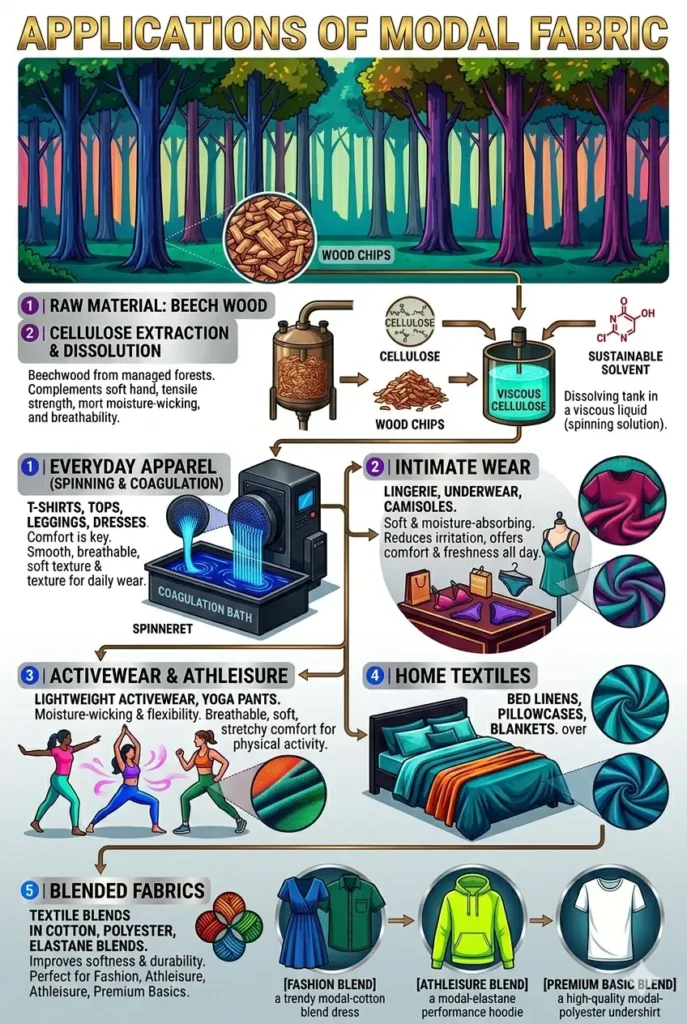
Due to the softness, breathability, and resilience of Modal, it has a wide range of applications in the fashion, home textile, and performance industries. Whether for high-end fashion or everyday basics, Modal is a great fit.
Many brands prefer Lenzing Modal for premium activewear and home textiles because of its softness and durability.
1. Everyday Apparel
Comfort is key, and for that reason, Modal fabric is a great fit for t-shirts, tops, leggings, and dresses. Modal is great for daily wear because of its smooth, breathable, and soft texture.The growing popularity of modal clothing fabric in modern fashion comes from its silky texture, breathability, moisture-wicking properties, and long-lasting comfort for daily wear.
2. Intimate Wear
Lingerie, underwear, and camisoles benefit from modal because it is soft and absorbs moisture. These properties work together to reduce irritation and offer enhanced comfort and freshness all day and night.
3. Activewear & Athleisure
For lightweight activewear and yoga pants, modal fabric is a great pick for its moisture-wicking properties and flexibility.
Paired with spandex, it creates a breathable, soft, and stretchy fabric that is desired for comfort in physical activity. In the debate of modal fabric vs cotton, modal is commonly preferred for activewear and loungewear because of its moisture-wicking ability.
4. Home Textiles
Bed linens, pillowcases, and blankets all benefit from modal. Modal is a visually appealing fabric with a cool, soft touch that drapes nicely and keeps its color over time.
5. Blended Fabrics
In cotton, polyester, and elastane, modal fabric is a great blended fabric. These combinations improve the softness and durability of the product, creating fabrics that work great in fashion, athleisure, and premium basics.
Variations/Types of Modal Fabric
The versatility of Modal fabric is a consequence of its multiple variations. Each of these variations may be tailored to achieve better performance and durability, increased sustainability, or even be better suited for a niche field in fashion and textiles.
1. Standard Modal
This is the archetypal Modal fiber, smooth and silky to the touch, that is used in apparel and home textiles. Its softness, strength, and breathability of the Standard Modal fiber make it an ideal textile for everyday and high-comfort garments.
2. Micro Modal
The next tier down of Micro Modal fibers is softer and finer than the regular Modal. These fibers are great for producing lightweight fabrics that feel like a second skin.
Hence, they’re ideal for casual apparel such as intimates and loungewear, and even premium basics. Micro Modal is one of the softest forms of modal clothing fabric used in premium basics and loungewear.
3. Modal Blends
Modal Blends are created when Modal is combined with other fibers such as cotton, spandex, or polyester. These combos are great for increasing the fabric’s stretchiness and comfort. You often see these in clothes for athletes or even high-performance apparel to make them more fitted and durable.
4. High-Tenacity Modal
This version has been engineered to be even stronger and, hence, more durable, with a higher level of abrasion resistance. You often see this variety of Modal in industrial textiles and technical garments, as well as other uses that need sustained and prolonged wear.
5. Eco-Enhanced Modal
This version reduces energy consumption and chemical waste produced, to create a more sustainable option. It is the option that is most appealing to brands that are Eco-Conscious and consumers that are more environmentally responsible. Check out 8 Reasons Why Lenzing Modal Fiber is Dominating Sustainable Fashion by Hula Global.
Environmental Impact of Modal Fabric
The types of fabrics and their environmental impacts depend greatly on a variety of factors that include production, processing, and eventual disposal of the fabric.
In the case of all types of fabrics, one must examine the entire life cycle of the fabric, not just the beginning.
Some types of biodegradable fabrics include cotton, wool, and silk.
Moreover, modal is biodegradable, but it may take a lot of water and space, and may be chemically intensive during the formation and processing.
An example of this includes the farming of cotton, which may be water and chemically-intensive and may degrade soil and water availability in areas.
A type of fabric that remains non-biodegradable includes fleece, polyester, nylon, and acrylic. These types of fabrics also take a lot of energy to produce.
In addition to these negatives, they also shed microplastics, which eventually make their way to the food chain and may actively harm ocean life.
However, on the other hand, these types of fabrics may outlast the biodegradable fabrics such as cotton, wool, and silk. Comparing modal fabric vs cotton also highlights differences in water usage, biodegradability, and production methods.
Some synthetic fabrics include polyester, Tencel, and Modal fabrics, which may also be made from recycled and regenerated materials. These fabrics may take a middle ground in producing and recycling.
These fabrics improve on other factors, such as energy consumption and biodegradability. However, in some cases, the recycling of these fabrics also takes a lot of resources.
At the end of the day, the impact of modal fabric all depends on its production, responsible sourcing, clean production technologies, and consumer usage and disposal.
Compared to traditional rayon, Lenzing Modal offers a more environmentally responsible alternative for modern textile production.
References
- Circle Economy. (2024, Nov 29). Just 0.3% of materials used by the global textile industry come from recycled sources…Link circle-economy.com
- Ellen MacArthur Foundation. (2017). A New Textiles Economy: Redesigning Fashion’s Future.Link content.ellenmacarthurfoundation.org
- European Environment Agency. Textiles and the environment: The role of design in Europe’s circular economy.Link eea.europa.eu
- Y. Spyridis et al. (2024). Autonomous AI-enabled Industrial Sorting Pipeline for Advanced Textile Recycling. [Preprint PDF link]arXiv
- R. Rathinamoorthy & S. Raja Balasaraswathi (eds.). (2024). Microfibre Pollution from Textiles: Research Advances and Mitigation Strategies. CRC Press. [Book info]Routledge
Wanna get in touch with us. You can also Book a 1-on-1 Call Session BOOK NOW
5 Responses
The design is clean and user-friendly, making it a pleasure to read and navigate.
I am truly thankful to the owner of this web site who has shared this fantastic piece of writing at at this place.
This is really interesting, You’re a very skilled blogger. I’ve joined your feed and look forward to seeking more of your magnificent post. Also, I’ve shared your site in my social networks!
I’m often to blogging and i really appreciate your content. The article has actually peaks my interest. I’m going to bookmark your web site and maintain checking for brand spanking new information.
Your posts always remind me why I love being part of this community