

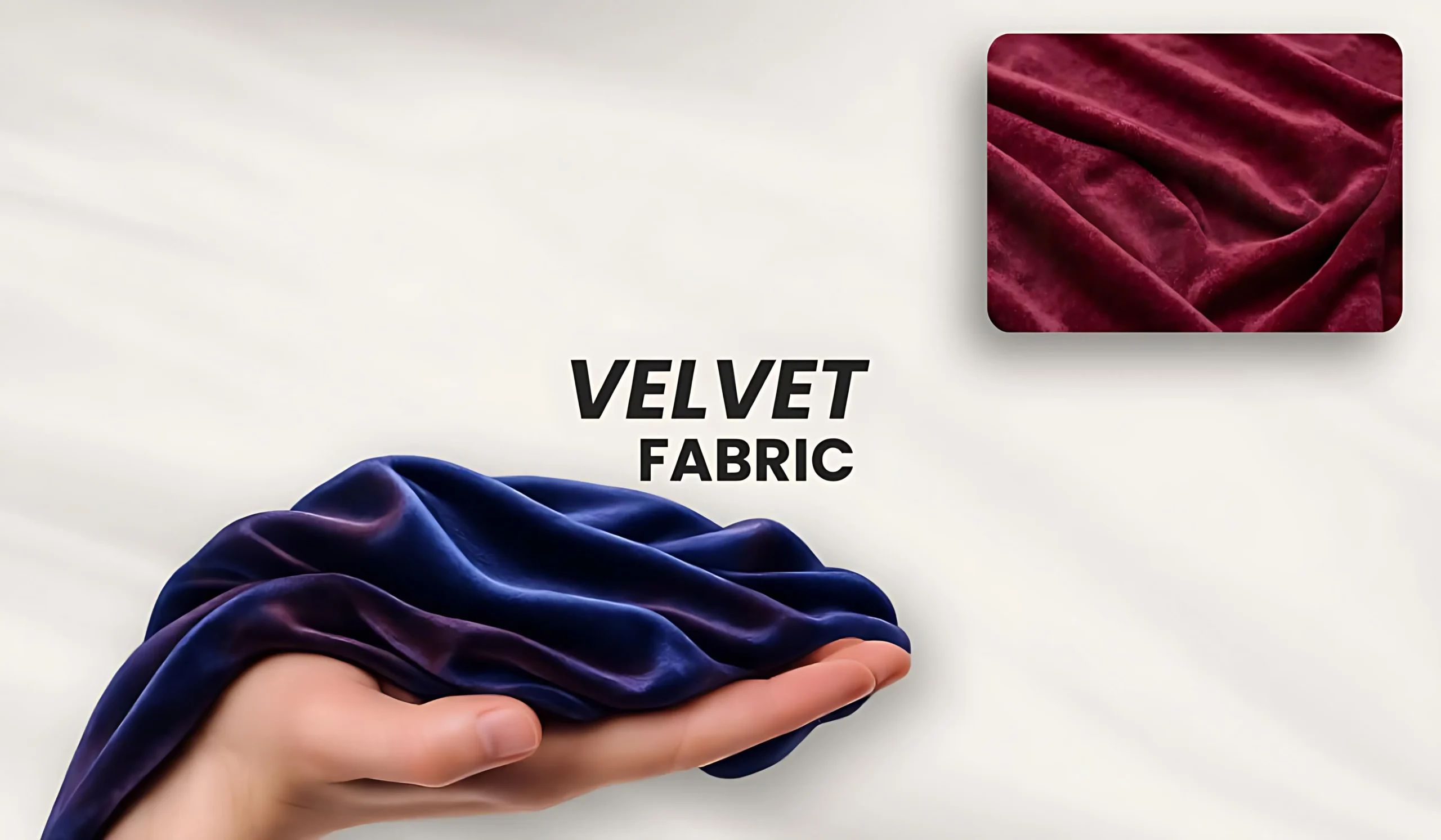
Velvet is one of the fabrics that is almost like a secret treat to yourself—very soft and smooth to the skin, with a slight shine that is just right.
Velvet is not only a fabric; it’s a whole vibe, reminding you of fancy dance halls lit only by candles and armchairs that are comfortable and warm next to the fire. Basically, velvet is a woven fabric characterized by a short, densely packed pile of fibers of the same length, giving the front side a very soft surface while the backside remains firm and of a normal texture.
This pile makes velvet extremely rich visually and very invitingly tactile, and thus quite different from such fabrics as silk or satin, which are also soft but have no pile. Velvet in any form, whether it is the material of a dress or the fabric covering a piece of furniture, has the power to elevate the most mundane things to the level of luxury, thus combining the latter with an almost imperceptible quietness of the elegant kind and, consequently, making it very difficult to resist.
From Ancient Weaves to Renaissance Opulence
Velvet’s travel through time is essentially a story of trade routes, royal courts, and the art of crafting. Historians reckon that the first velvet-like fabric could be the one made of piled loops of silk or linen, which might have been in the Far East.
The earliest pile-woven fabrics date back to around 2000 BCE and are found in Egypt, where linen fabrics with looped piles were identified as the first velvet-like textiles. These first were works of many hours, and quite a few used silk and linen to imitate the soft, tufted surfaces we are familiar with.
By the 4th century BCE, piled carpets found at the Pazyryk site in Siberia suggest that similar methods were standard across different parts of Asia and may have been spread by the Silk Road.
The fabric truly blossomed in the Middle East during the Islamic Golden Age, around the 8th century CE in Baghdad, where references to “kutuf”—a piled silk cloth appear in Arabic literature, adorning the courts of caliphs like Hisham ibn Abd al-Malik.
From there, it journeyed westward, reaching Europe by the 13th century through Mongol invasions and trade networks, evolving into the warp-cut-pile weaves that defined medieval luxury.
The 14th-century Italian city-states, such as Venice, Genoa, and Florence, turned into velvet powerhouses, fabricating elaborate silks dyed in rich colors for the nobility and clergy – picture Michelangelo drawing patterns or Leonardo da Vinci admiring the workings of the loom. It was of such great value that sumptuary laws limited its use only to the privileged; thus, it became a symbol of both wealth and piety.
Evolution came with the Renaissance (1400–1600), when drawloom innovations allowed for patterned velvets with cut and uncut piles, creating shimmering motifs of pomegranates and florals that graced papal vestments and royal trains. The Industrial Revolution in the 19th century marked a turning point: steam-powered Jacquard looms doubled production efficiency, slashing costs and democratizing access to velvet suits for the middle class, anyone?
Key innovations included the 1830s “double velvet” technique on Jacquard looms, which wove two pieces simultaneously, and later synthetic fibers like rayon in the 20th century, blending tradition with affordability. Today, digital printing and waterless dyeing push velvet toward sustainability, ensuring this ancient art form endures without exhausting the planet.
The Intricacy of Making Velvet Fabric
Making velvet is definitely not easy – it requires precision in a very delicate way on special looms, thus essentially transforming common yarns into a magnificent product.
The very first step in production is choosing the fiber, which is considered the core of the fabric.
In the past, velvet was made of pure silk for that airy, shiny effect. Still, the velvet can now be made of different fibers: cotton for lightness and good air permeability, wool for warmth, linen for a more natural textured look, and even polyester for a strong, long-lasting fabric. Each material affects the drape and feel of the fabric – silk makes it light and shiny, whereas cotton makes it stiff and matte.
The process of weaving is central to the story, and it is typically done using warp-pile techniques on a double-cloth loom.
Two pieces of fabric are woven together – the faces are one against another, and the layers are connected by the extra warp yarns, which are looped over rods or wires.
The result is the pile: the floats of the top layer form the velvety surface, while the bottom layer provides support.
Another layer is introduced: the sharp blade runs between the layers, separating them and producing two identical pieces of velvet, each with an upright nap.
In weft-pile fabrics such as velveteen, the yarns are arranged horizontally to create a shorter, denser pile, and this is how the story changes. There is also a knitted fabric that stretches and is a nice alternative for contemporary fashion.
Finishing seals the deal: steaming raises the pile for evenness, shearing trims stray fibers, and pressing enhances sheen without flattening the nap. Dyeing often post-weaving – requires care to ensure uniform penetration of the pile, and eco-friendly methods like digital printing minimise water use. It’s a process that’s as much art as engineering, demanding skilled hands (or machines) to balance luxury with practicality.
Properties That Enchant
Velvet is a fascinating fabric. It’s basically those kinds of things that are most nice to the sense of the human being—the fabric is exceptionally soft, rich, and it has a tiny bit of drama in it. The top velvet, in fact, has a very dense, very uniform pile (generally 1-3 mm high), which is why it reflects light in a very soft way, giving a bit of a glow to the fabric, instead of the intense shining, which we usually get from metal surfaces. If you try, the luxurious short hair gives back in a very soft manner, just like velvet cake, it keeps warm as it wraps in a very cool way.
To break it down, here’s a quick look at velvet’s standout traits:
| Property | Description | Comparative Note (vs. Similar Fabrics) |
| Texture | Ultra-soft, dense pile for a velvety hand-feel; smooth backing for stability | Softer and more tactile than satin’s sleek slipperiness |
| Appearance | Subtle sheen with depth; colors appear richer due to light diffusion | Less glossy than silk but more dimensional than matte cotton |
| Drape | Excellent fluidity, especially in silk or rayon blends; holds shape in structured weaves | Drapes better than stiff wool but less flowy than chiffon |
| Durability | Resists abrasion in synthetics; natural fibers may crush over time | Tougher than delicate silk for upholstery, per industry tests |
| Insulation | High warmth retention from pile trapping air; breathable in cotton variants | Warmer than lightweight satin, ideal for fall layers |
| Weight | Medium (6–12 oz/yd²); varies by fiber—light for apparel, heavier for upholstery | Heavier than satin (4–8 oz/yd²) for more substance |
Where Velvet Shines: From Runways to Living Rooms
Velvet’s appeal is mainly due to its ability to be used in just about anything, be it a luxurious dress or a sofa that gets a lot of use. In the fashion industry, it is the go-to fabric for gala gowns and party dresses, giving the silhouette a charming look with its flow and making the fabric shine to attract attention. Think red carpet or a bride’s finishing touch. Accessories such as scarves, gloves, and handbags add a textural and lively element to the outfit, whereas outerwear (coats, jackets) is more of a fashion plus turn, kept for warmth while layering.
Industrially, velvet rules upholstery, transforming chairs and sofas into plush havens with its durability and noise-dampening pile—perfect for hotels or theaters. In home decor, it softens curtains and cushions, blocking light while insulating rooms; in automotive interiors, treated variants are used for seat covers that withstand wear. Even bedding gets a velvet trim for that hotel-luxe vibe. Brands like Gucci and Ralph Lauren weave it into ready-to-wear, proving its commercial clout.
Velvet Variations to Suit Every Mood
Velvet isn’t one-note – its types span weaves, finishes, and fibers, each with a personality. Here’s a rundown:
- Silk Velvet: The OG luxury, lightweight and luminous; ideal for gowns but pricey and delicate.
- Cotton Velvet (Velveteen): Matte and sturdy with a short weft pile; breathable for casual jackets or upholstery.
- Polyester/Nylon Velvet: Affordable and resilient; great for everyday bags or high-traffic furniture.
- Crushed Velvet: Textured via twisting or pressing for a wrinkled, bohemian vibe; fun for costumes or throws.
- Panne Velvet: Flattened pile for a silky sheen; stretchy for activewear.
- Embossed Velvet: Patterns stamped in for raised designs; dramatic for wall hangings.
- Pile-on-Pile: Varying heights for motifs; heirloom-quality for curtains.
- Stretch Velvet: Spandex blend for form-fitting dresses; modern and forgiving.
Finishes like devoré (burnout patterns) or hammered (dappled texture) add flair, while weaves toggle between warp (traditional upright pile) and weft (denser, shorter nap).
Velvet’s Shadow: Weighing Environmental Footprints
Velvet may be a luxurious fabric, but its production contributes to global warming. However, making better choices can help reduce the impact. The environmental impact of the fabric is significant at the very beginning of the lifecycle: the production of the fibres requires a lot of water (silk needs 10,000 litres per kg, cotton 20,000 litres per kg), energy, and chemicals, and dyeing contributes to the release of pollutants into wastewater. The double-cloth method used in weaving doubles material consumption, thereby increasing waste, whereas synthetic fibers such as polyester emit microplastics during washing, polluting the oceans.
Sustainability hinges on fibers; virgin polyester is fossil-fuel hungry and non-biodegradable (up to 300 years to break down), but recycled versions cut emissions by 50% and divert plastic waste. Organic cotton or TENCEL™ lyocell slashes pesticide use and water use by 90%, and biodegrades in months. End-of-life? Synthetics clog landfills; naturals compost better, but blended velvets complicate recycling. Only 1% of textiles are truly circular today.
Progress shines in innovations: waterless dyeing, closed-loop factories, and certifications like GOTS (organic standards) or GRS (recycled content) guide greener paths. Reports from Textile Exchange note polyester dominates (57% of fibers), but recycled uptake grew 20% in 2023, signaling hope. Choose wisely, and velvet can be part of a sustainable wardrobe.
Velvet in the Spotlight: How It Stacks Up
For those eyeing velvet against rivals, here’s a snapshot comparison with satin (shiny sibling) and common upholstery picks like chenille or leather, focusing on feel, use, and eco-angle:
| Fabric | Texture & Sheen | Durability & Care | Best Uses | Sustainability Edge |
| Velvet | Plush pile, subtle glow | Medium-high; pile mats if wet | Eveningwear, sofas | Recycled variants beat virgin synthetics; organic > conventional |
| Satin | Smooth, high-gloss shine | Delicate; snags easily | Linings, dresses | Silk satin luxurious but water-intensive; poly less eco |
| Chenille | Fuzzy, yarn-like pile | Soft but pills quickly | Curtains, throws | Cotton-based; recyclable but dyes pollute |
| Leather | Supple, natural grain | Tough; ages gracefully | High-end upholstery | Ethical sourcing key; tanning toxic—veg alternatives greener |
Velvet wins for warmth and depth, but satin’s easier on the wallet for beginners.
References
- Bide, M. (2016). *Velvet and patronage: The origin and historical background of Ottoman and Italian velvets*. Textile Society of America Symposium Proceedings. https://digitalcommons.unl.edu/tsaconf/1993/
- Chen, H.-L., & Burns, L. D. (2008). *Textiles and fashion: Materials and technology*. Woodhead Publishing.
- Holst, B. (2015). A technical review of emerging technologies for energy and water efficiency and pollution reduction in the textile industry. *Journal of Cleaner Production*, 107, 1–12. https://doi.org/10.1016/j.jclepro.2015.02.083
- International Finance Corporation. (2023). *Strengthening sustainability in the textile industry*. World Bank Group. https://www.ifc.org/en/insights-reports/2023/strengthening-sustainability-in-the-textile-industry
- Kant, R. (2012). Textile dyeing industry an environmental hazard. *Natural Science*, 4(1), 22–26. https://doi.org/10.4236/ns.2012.41004
- Monnas, L. (2008). *Merchants, princes and painters: Silk fabrics in Italian and northern paintings, 1300–1550*. Yale University Press.
- Sülar, V., & Devrim, Ö. (2019). Biodegradability of viscose fabrics. *Journal of Engineered Fibers and Fabrics*, 14. https://doi.org/10.1177/1558925019865321
- Textile Exchange. (2023). *Materials market report 2023*. https://textileexchange.org/app/uploads/2023/11/MMR_2023.pdf
- Watt, M. (2011). Renaissance velvet textiles. *The Metropolitan Museum of Art Heilbrunn Timeline of Art History*. https://www.metmuseum.org/toah/hd/velv/hd_velv.htm
- Zambrano, M. C., Pawlak, J. J., Daystar, J., Ankeny, M., & Venditti, R. A. (2021). Cellulose crosslinking with glutaraldehyde and its effects on fabric properties. *Textile Research Journal*, 91(5–6), 678–689. https://doi.org/10.1177/0040517520959250
- Zuin, V. G., & Roso, M. (2023). A review of sustainability standards and ecolabeling in the textile industry. *Sustainability*, 15(15), 11589. https://doi.org/10.3390/su151511589
3 Responses
Kudos to the writer for explaining Velvet Fabric fabric in a way that’s accessible to everyone. It’s refreshing to learn about sustainable options in the fashion industry.
Thanks for sharing. I read many of your blog posts, cool, your blog is very good.
Thank you for your sharing. I am worried that I lack creative ideas. It is your article that makes me full of hope. Thank you. But, I have a question, can you help me?