

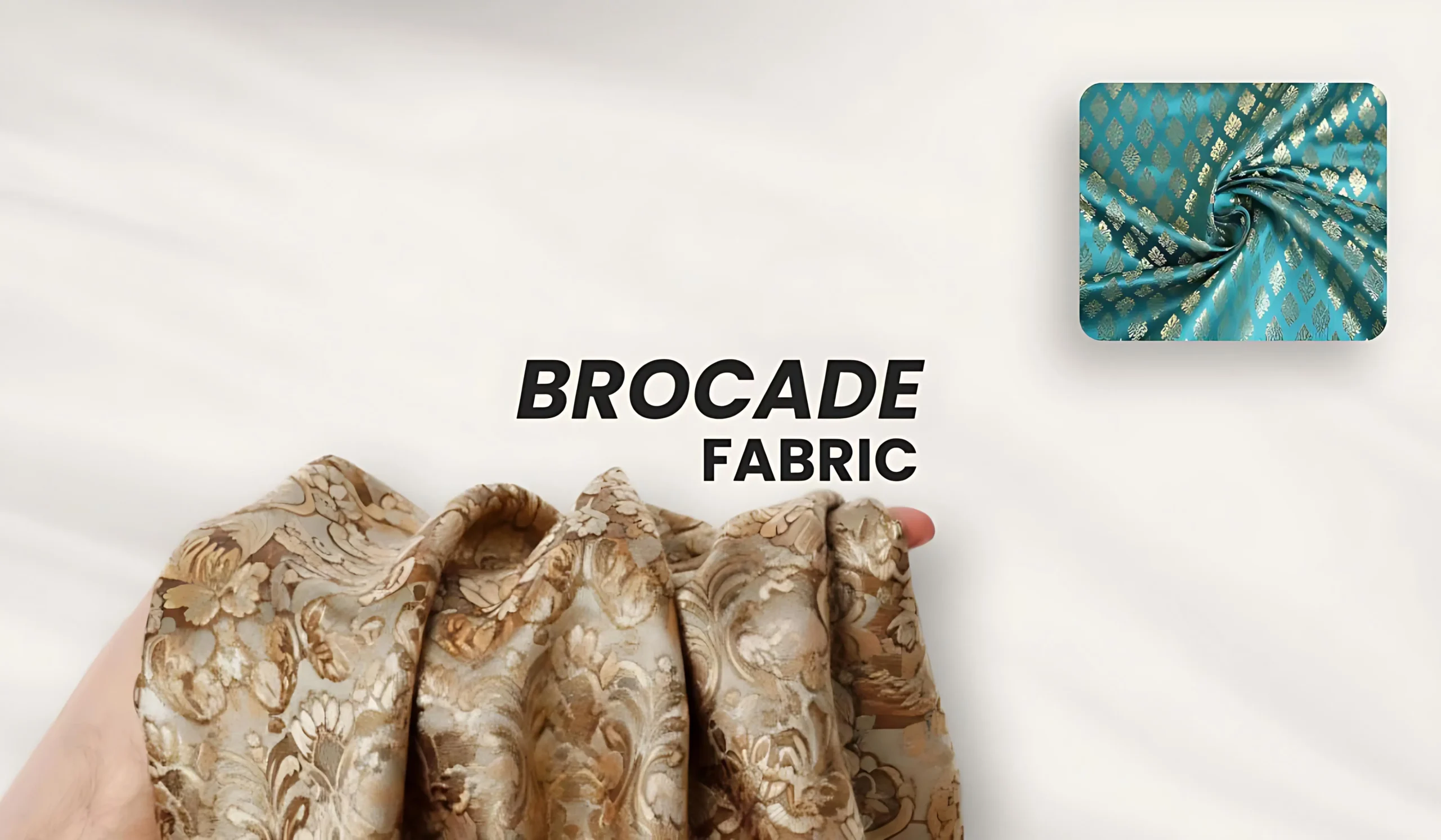
Introduction: What is Brocade Fabric?
I’ve got a serious weakness for brocade. Like, the kind where I’ll stop dead in the middle of a market in Varanasi just to run my hand over a saree and whisper “hello, gorgeous” under my breath. It’s ridiculous. My friends roll their eyes. But you get it, right? That heavy, shimmering, raised-pattern magic that makes you feel like royalty even when you’re just buying vegetables.
Brocade Fabric isn’t a fibre – it’s a weaving technique. You take a base cloth (usually satin or twill, so it’s already shiny) and then float extra threads (often metallic) across the top to create raised patterns. It looks embroidered, but it isn’t. No needle ever touched it. That’s the cheat code that makes brocade fabric so impressive.
Old-school versions were pure silk with real gold and silver threads, stuff only emperors could afford. These days, you’ve got everything from cotton brocade that feels like a dream in summer to polyester versions that cost less than your coffee habit.
So, here’s my attempt at explaining why this fabric has had me in a chokehold for years without sounding like a textbook or a sales brochure.
History of Brocade
Brocade’s roots run deep, tangled in the threads of ancient trade routes and imperial courts. It’s one of those fabrics that evolved from a guarded secret to a global status symbol, adapting to each culture it touched along the way.
1. Origin:
The earliest whispers of brocade date back to China’s Warring States period (475–221 BCE), when artisans wove elaborate silk patterns with supplementary wefts to create an embossed effect. From Nanjing’s Yunjin (cloud brocade) to Chengdu’s Shu brocade, it originated in silk-rich dynasties like the Han (206 BCE–220 CE) and was reserved for emperors and nobility.
The name itself derives from the Italian “broccato,” meaning “embossed cloth,” hinting at its later European flair, but the technique likely drew from even older Indian gold-cloth mentions in the Rig Veda (c. 1500 BCE).
2. Evolution:
By the 6th century CE, Byzantine monks smuggled silkworms from China, turning Constantinople into a brocade powerhouse with Persian-inspired Christian motifs. It spread via the Silk Road to Persia, India (as Kimkhwab or zari-woven sarees), and Europe, where the Renaissance Italians elevated it with hyper-detailed designs for the elite.
In India, Banarasi brocades became wedding staples, blending Mughal influences with local zari (gold/silver threads). By the Middle Ages, it symbolised wealth; Byzantine emperors valued it above gold, and Burgundian courts flaunted fur-trimmed versions.
3. Key innovations:
The game-changer was Joseph Marie Jacquard’s 1804 loom, which used punch cards for complex patterns, slashing production time and costs. This democratized Brocade Fabric, shifting it from handlooms to factories. In the 20th century, synthetics like rayon and polyester joined the mix, while today’s digital Jacquard looms enable eco-blends and revived traditional crafts, like Guatemalan Maya backstrap weaves or Mali’s artisan hubs.
Manufacturing Process of Brocade Fabric
Crafting brocade is like a skill-induced art; every thread has its cue, and one wrong note ruins the symphony. It’s labour-intensive, but the results are worth it.
1. Fibre selection:
Silk reigns supreme for its lustre and drape (80–95% in traditional pieces), often mulberry for smoothness or tussar for texture. Cotton or wool adds durability and affordability; synthetics like polyester (up to 70%) mimic shine at a lower cost. Metallic zari threads (gold- or silver-wrapped cotton or synthetics) provide the sparkle – real metals were once used, but now it’s mostly aluminium for cost.
2. Weaving/Knitting process:
Almost always shuttle-woven on Jacquard looms (no knitting here, brocade’s structure demands weaving). Warp threads (silk/cotton) form the base; standard weft holds it together, while supplementary weft (thicker, often metallic) floats over sections to build raised designs.
Patterns are encoded on punch cards or digital files, guiding harnesses to lift specific warps. It’s discontinuous in spots (extra weft only where needed), creating those 3D effects – floral scenes might take hours per inch on handlooms.
3. Finishing techniques:
Post-weave, it’s scoured to remove impurities, then dyed (yarn-dyed for colourfast patterns, avoiding post-weave dips that blur designs). Calendering (heated rollers) smooths and polishes for sheen; some get anti-pilling treatments or embossing. Heavy pieces might be steamed to set the structure, ensuring the raised motifs pop without fraying.
Properties & Characteristics
Brocade’s charm lies in its contradictions: heavy yet elegant, flashy yet subtle. It’s not for everyday romps.. more for moments you want to remember.
In a nutshell, it’s theatrical, breathable silk brocades suit summer formals, while wool blends warm winter coats. But watch for snags; those floats are Achilles’ heels.
| Property | Description | Typical Performance |
| Texture/Design | Raised, embossed patterns (floral, geometric) via supplementary weft; shiny face, textured back | Excellent-3D effect, non-reversible |
| Weight/Feel | Dense and substantial; silk is soft and cool, synthetics are stiffer | Heavy (200–400 GSM); luxurious but not drapey |
| Durability | Strong weave resists wear, but metallics snag; good tear strength | High (silk/cotton blends best) |
| Breathability | Varies—silk high, heavy metallics low; cotton versions better for warmth | Moderate; traps heat in dense weaves |
| Shine/Lustre | High from satin/twill base and metallics; reflects light dramatically | Outstanding (zari elevates it) |
| Wrinkle Resistance | Fair—stiffer types hold shape, but silk creases easily | Moderate |
| Care | Dry clean only; silk fades in the sun, synthetics are machine-washable (gentle) | Delicate; avoid irons on metallics |
| Pilling/Snagging | Prone in loose weaves; high thread counts (70+) resist better | Common issue with extras |
Applications
Brocade turns the mundane into the magnificent, popping up where drama is the dress code.
1. Fashion/Commercial:
Evening gowns, bridal lehengas/sarees, jackets, vests, think Sabyasachi’s zari masterpieces or Reformation’s eco-twists. Accessories like clutches, belts, or even sneakers get a luxe edge. It’s big in cultural wear: Indian weddings, Chinese festivals, or European opera attire.
2. Home/Industrial:
Upholstery for sofas/chairs (durable against wear), curtains/drapes for light-filtering opulence, throw pillows, or wall hangings are some of the most common applications of Brocade Fabric. In theatre, it’s costume gold for historical epics; religiously, altar cloths or vestments. Industrially, it’s in high-end banners or automotive trims, where patterns add prestige without bulk.
Variations/Types
Brocade’s family tree is vast, branching by fibre, weave, and region, each with its own personality.
- Silk brocade: The OG – supple, shimmering, for heirloom gowns; Yunjin or Song brocades from China are UNESCO treasures.
- Cotton brocade: Lighter, breathable; ideal for casual kurtas or summer upholstery; Himru from India mixes cotton with silk for sarees.
- Cotton brocade: Lighter, breathable; ideal for casual kurtas or summer upholstery; Himru from India mixes cotton with silk for sarees.
- Wool brocade: Warm, structured; great for coats or medieval-revival tapestries.
- Polyester/synthetic brocade: Affordable, wrinkle-resistant; standard in mass-market eveningwear or curtains.
- Zari/Kimkhwab brocade: Indian/Persian style with gold/silver threads; discontinuous weave for sarees or sherwanis.
- Continuous vs. discontinuous: Continuous leaves floating backs (cut or loose); discontinuous tucks extras in for smoother reverses.
- Floral/geometric: Motif-driven – bold blooms for romance, paisleys for heritage.
Environmental Impact & Sustainability
Brocade’s footprint mirrors its fibres: silk’s a mixed bag, synthetics a headache. From cradle to grave, it’s resource-heavy, but greener paths exist.
1. Lifecycle analysis:
Production guzzles water (silk sericulture: 10,000 litres/kg) and energy (Jacquard looms are efficient, but dyeing adds chemicals). Silk farming can harm biodiversity if non-organic; polyester sheds microplastics, contributing 35% of ocean pollution. Weaving waste (cut floats) piles up, and end-of-life? Landfills, as metallics, hinder recycling. Transport via Silk Road echoes today—global shipping amps carbon.
2. Recyclability:
Natural Brocade Fabric (silk/cotton) biodegrades in 4+ years if untreated, but dyes slow it down. Synthetics? Near-zero without tech like chemical recycling. Upcycling scraps into bags helps, but only 1% of textiles are truly circular.
3. Sustainability shifts:
Opt for organic/peace silk (no boiled cocoons), GRS-certified recycled polyester, or Tencel blends. Closed-loop dyeing cuts water use by 90%; handloom traditions (e.g., Mali women weavers) lower energy.
Certifications like GOTS or OEKO-TEX flag low-impact versions – Stella McCartney’s using them. Still, fast-fashion brocade floods markets; slow it down by buying vintage or heirlooms.
Comparison Table: Brocade vs. Similar Patterned Weaves
| Fabric | Weave Type | Typical Fiber | Texture/Design | Reversibility | Durability | Breathability | Price |
| Brocade | Supplementary weft (raised) | Silk/poly/metallic | 3D, ornate | No | High | Varies (low in heavy) | High |
| Damask | Satin/warp-faced contrast | Silk/linen | Flat, tonal | Yes | High | Good | Medium |
| Jacquard | Any complex (flush patterns) | Cotton/wool | Varied, woven | Varies | Moderate | High | Low–medium |
We’ve been head-over-heels obsessed with this Brocade Fabric at Hula Global for longer than we care to admit (basically since the day we started). There’s just something about the way the light catches those raised, shimmering patterns, as if the cloth itself were telling little golden stories with every movement.
We go properly nuts over every single meter that comes through our doors. Our artisans treat each thread like it’s precious (because, well, it kind of is), hand-weaving, inspecting, fussing until every saree, every indo-western suit, every cushion cover feels like it was made just for you.
Want a brocade saree that makes aunties at weddings whisper, “Where did she get that?” Done. A sharp suit-pant set that looks like it costs a fortune but doesn’t? We’ve got your back. Dreamy bedsheets that turn your bedroom into a palace even when the alarm clock says otherwise? Say less.
Brocade Fabric isn’t loud luxury. It’s the quiet, delicious kind—the sort your hand keeps drifting to touch, the kind that turns Tuesday nights into something a little magical. It’s tradition and glamour having a beautiful love child that somehow never goes out of style.
And the best part? These pieces are meant to be lived in, loved hard, and handed down one day with stories attached. Affordable heirlooms, turns out that’s not an oxymoron after all.
References
Collier, B.J., Bide, M. and Tortora, P.G. (2009) *Understanding textiles*. 7th edn. Upper Saddle River, NJ: Pearson Prentice Hall.
Emery, I. (1994) *The primary structures of fabrics: An illustrated classification*. Washington, DC: Thames & Hudson.
Higgins, L. and Anand, S. (2017) ‘Sustainability in textiles’, in *Textiles and fashion*. 2nd edn. Woodhead Publishing.
International Finance Corporation (2023) *Strengthening sustainability in the textile industry*. Washington, DC: IFC. Available at: https://www.ifc.org (Accessed: 23 November 2025).
Kadolph, S.J. (2010) *Textiles*. 11th edn. Upper Saddle River, NJ: Prentice Hall.
Muthu, S.S. (ed.) (2017) *Sustainability in the textile and apparel industries*. Cham: Springer.
Textile Exchange (2023) *Preferred fibre & materials market report 2023*. Available at: https://textileexchange.org (Accessed: 23 November 2025).
Udale, J. (2008) *Textiles and fashion*. Lausanne: AVA Publishing.
United Nations Environment Programme (2024) *Sustainability trends and gaps in the textile, apparel and fashion industries*. Available at: https://www.unep.org (Accessed: 23 November 2025).
Wikipedia contributors (2025) ‘Brocade’, Wikipedia, The Free Encyclopedia. Available at: https://en.wikipedia.org/wiki/Brocade (Accessed: 23 November 2025).
World Bank (2022) *Textile industry sustainability report*. Washington, DC: World Bank Group.
Yue, C. et al. (2024) ‘Sustainable circular practices in the textile product life cycle: A comprehensive approach to environmental impact mitigation’, *Sustainable Chemistry for the Environment*, 5, pp. 1–15.
Wanna get in touch with us. You can also Book a 1-on-1 Call Session BOOK NOW
Programs
- If you are exploring the idea of starting a fashion brand – Join the Masterclass
- If you are 100% sure of launching a clothing brand or are in the process of launching a clothing brand – Join the Bootcamp
- If you are looking for low MOQ supplier, inquire about the Co-pilot program.
- If you have a private label brand and you are looking to scale up – Join our Private Label Program.
- If you are looking for surplus & Liquidation deals – join our liquidation program.
- If you are not sure about joining the bootcamp, – Join the Masterclass to get a feel of what Bootcamp has to offer and if you still have questions, you can email us at hello@hulaglobal.com
Read more
2 Responses
I stumbled upon this captivating website and I think I may linger here for a while
I like this website very much, Its a real nice billet to read and receive info.Blog range